Hasegawa Chikuyō
Hasegawa Chikuyō, also known by the art name Suiken Chikuyō, was a Japanese ukiyo-e print designer and illustrator active during the early Meiji period. His birth and death dates remain unknown, and relatively little information
about his life has survived. He appears to have been active primarily from the late 1870s through the 1880s, although works attributed to him are known from at least the mid-1890s.
According to some Japanese sources, Chikuyō may have been a pupil of Utagawa Kunisada I, although this relationship has not been conclusively documented in modern scholarly literature. His birth name is reported as Hasegawa Kannosuke.
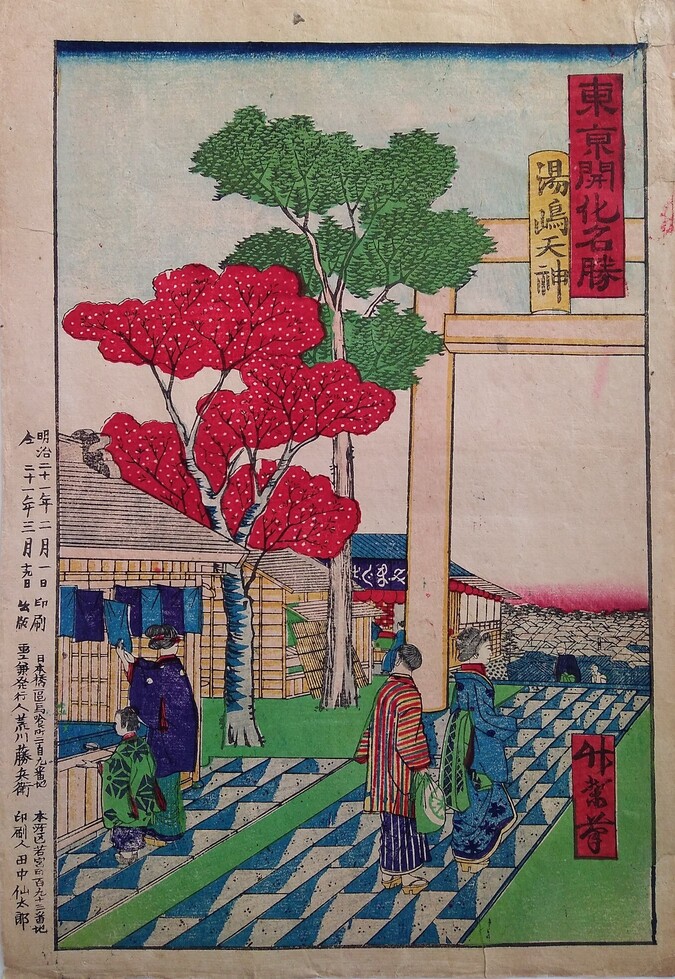
Chikuyō worked during the Bunmei Kaika (“Civilization and Enlightenment”) era, a period of rapid modernization and Westernization in Japan. Like several contemporary artists, including Hiroshige III, Kobayashi Kiyochika, and Utagawa Kuniteru,
he documented the profound social and urban transformations taking place throughout the country. His works frequently depict newly constructed Western-style buildings, modern transportation, industrial facilities, and changing cityscapes, providing
valuable visual records of Meiji Japan.
His artistic production is primarily associated with two genres: kaika-e, prints illustrating Japan`s modernization, and uchiwa-e, designs intended for fan prints. Among his best-known works is the series Twelve Scenic Views of Nikkō (Nikkō Meishō Jūnikei),
published in 1881, as well as View of the Tomioka Silk Mill in Jōshū, depicting one of the most important symbols of Japan`s early industrial development.
Although only a limited number of works are known today, Chikuyō`s surviving prints constitute an important visual testimony to Japan`s transition from a traditional society to a modern nation. His vivid compositions capture the architectural, technological,
and cultural changes that characterized the Meiji era while reflecting the evolving artistic tastes of the period.