Utagawa Kuniaki II
1835 ~ 1888Kuniaki II, also known as Hachisuka Kuniaki, was a Japanese ukiyo-e artist active during the final decades of the Edo period and the early Meiji era. Born into the Hirasawa family and later adopted by the Hachisuka family,
he studied under Utagawa Kunisada I and became a member of the influential Utagawa school. Throughout his career, he used several art names, including Hōsai, Ippōsai, and Hachisuka.
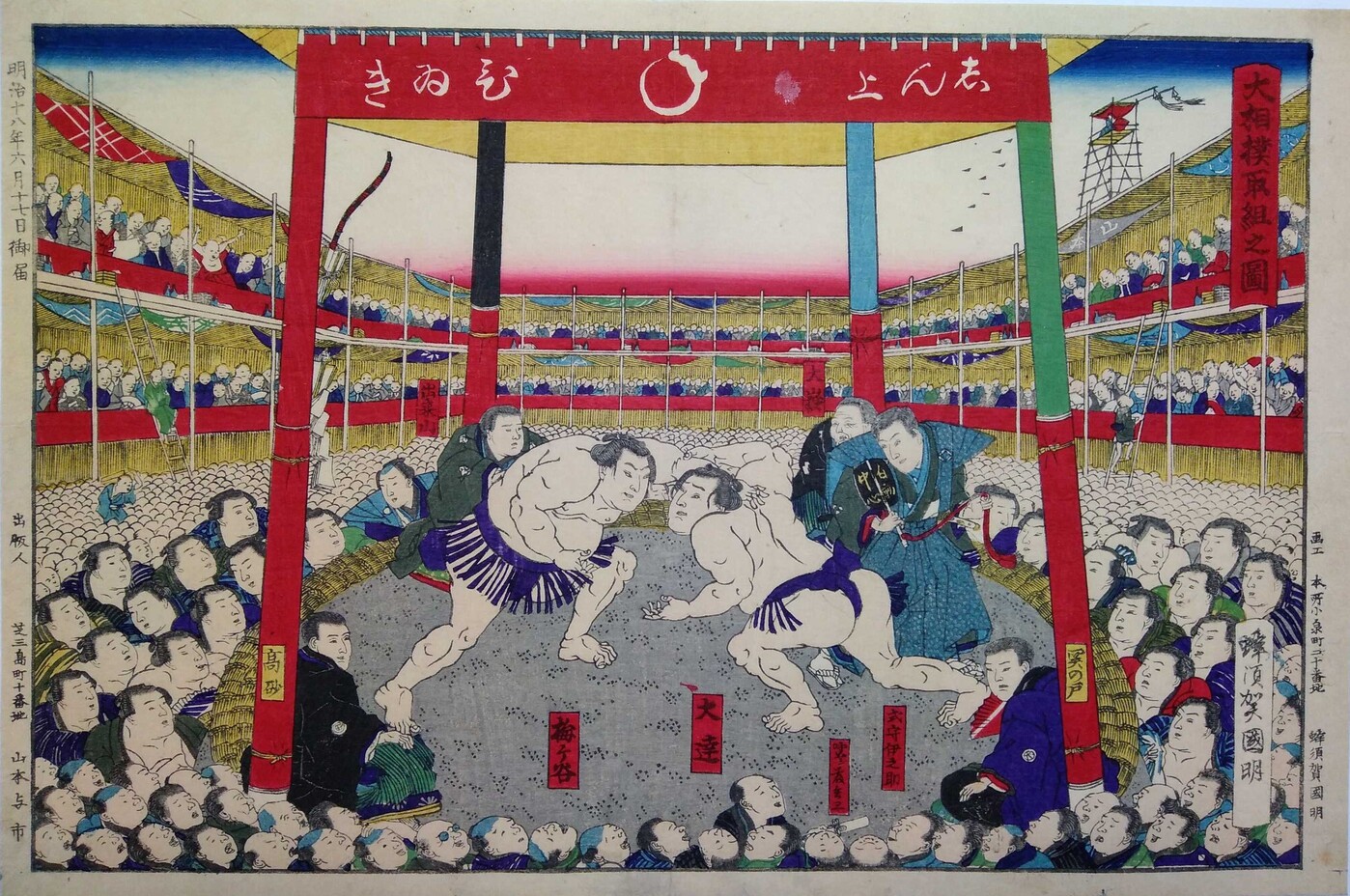
Kuniaki II produced a wide range of prints, including bijin-ga (pictures of beautiful women), yakusha-e (kabuki actor prints), sumo-e (wrestler prints), and Yokohama-e depicting foreigners and scenes inspired by Japan`s opening to the West.
His designs are characterized by bold compositions, expressive figures, and vivid colors typical of the late Utagawa style.
Working during a period of rapid modernization, Kuniaki II documented both traditional Japanese culture and the social changes of the nineteenth century. His prints capture the popular entertainment, fashions, and customs of a society transitioning
from the feudal Edo period into the modern Meiji era.
Although considered a relatively minor figure compared with some of his more famous contemporaries, his works are valued today for their artistic quality and historical significance. They are preserved in museum and private collections worldwide and
provide valuable insight into the popular culture and visual aesthetics of late Edo and early Meiji Japan. One of his sumo prints is believed to be the Japanese print depicted in Édouard Manet`s celebrated 1868 portrait of Émile Zola, a testament to the
international reach of Japanese art during the nineteenth century.