Toyohara Kunichika
1835 ~ 1900Toyohara Kunichika, born Ōshima Yasohachi in Edo (present-day Tokyo), was one of the last great masters of ukiyo-e and among the most influential woodblock print artists of the Meiji period.
He first studied under Toyohara (Ichiōsai) Chikanobu, from whom he adopted the surname Toyohara, and at the age of thirteen became an apprentice of Utagawa Kunisada, the leading ukiyo-e artist of his time. Although
deeply rooted in the Utagawa tradition, he never used the Utagawa name professionally.
Kunichika is best remembered for his dramatic yakusha-e (kabuki actor prints), which helped carry the ukiyo-e tradition into the modern era. His works are distinguished by expressive compositions and the bold use of
vivid synthetic pigments, including the bright reds and purples introduced to Japan during the Meiji period. These striking colors, combined with his ability to capture the psychological intensity of his subjects, gave
his prints a powerful theatrical presence.
A devoted admirer of kabuki theater, Kunichika spent much of his life attending performances, sketching actors, and socializing within theatrical circles. This close connection to the stage brought remarkable authenticity
and emotional depth to his actor portraits. Although he also produced bijin-ga (pictures of beautiful women), historical scenes, and illustrations for newspapers and magazines, kabuki remained the central focus of his artistic
career. His large-head actor portraits (ōkubi-e) and dramatic triptychs are now regarded among the finest achievements of late ukiyo-e.
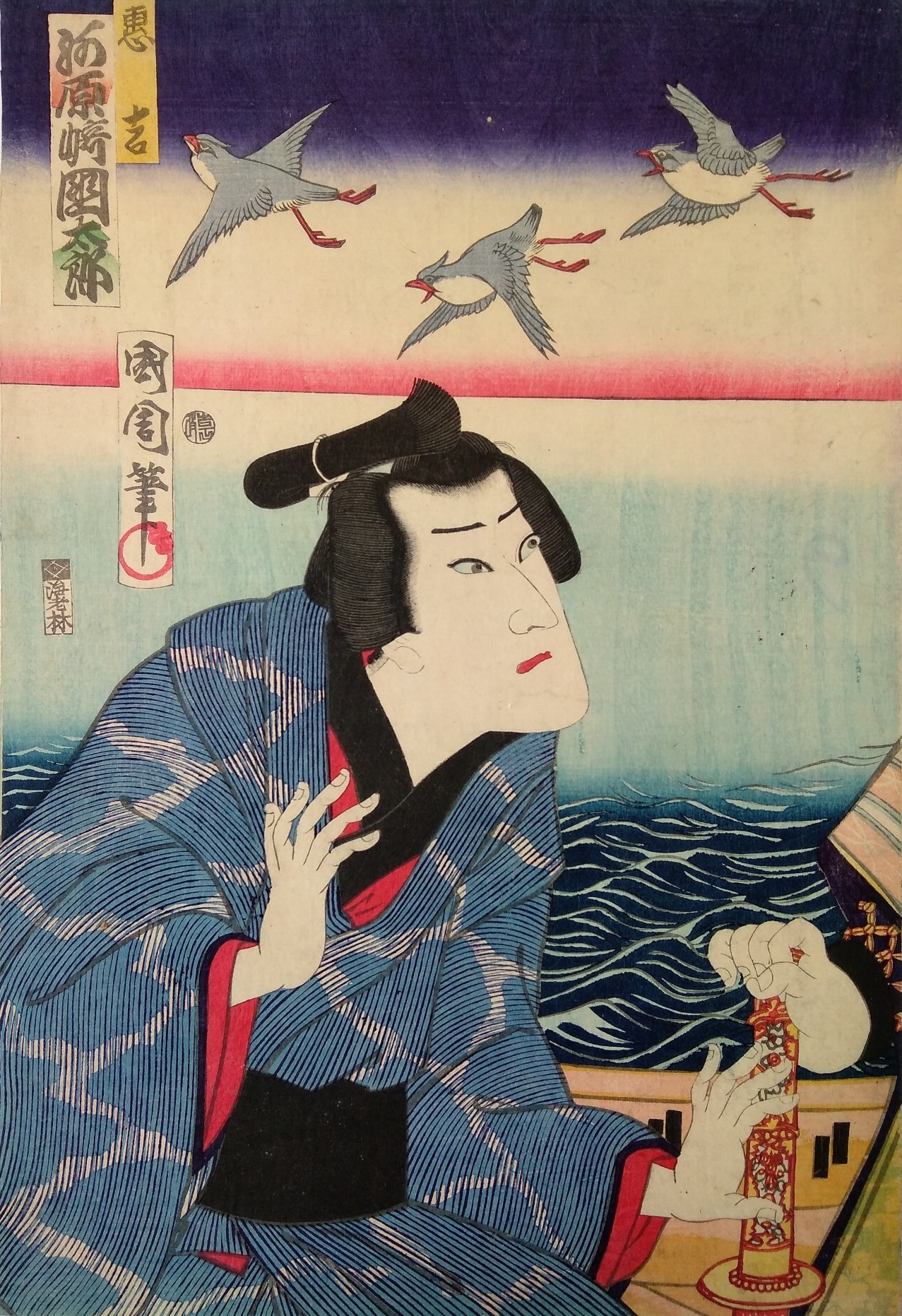
Kawaharasaki Kunitarō II as Keikichi from the Kabuki drama Hōraisan Soga no kaomise, which was performed for the first time at the Morita za theatre of Tōkyō.
USD$ 233.00

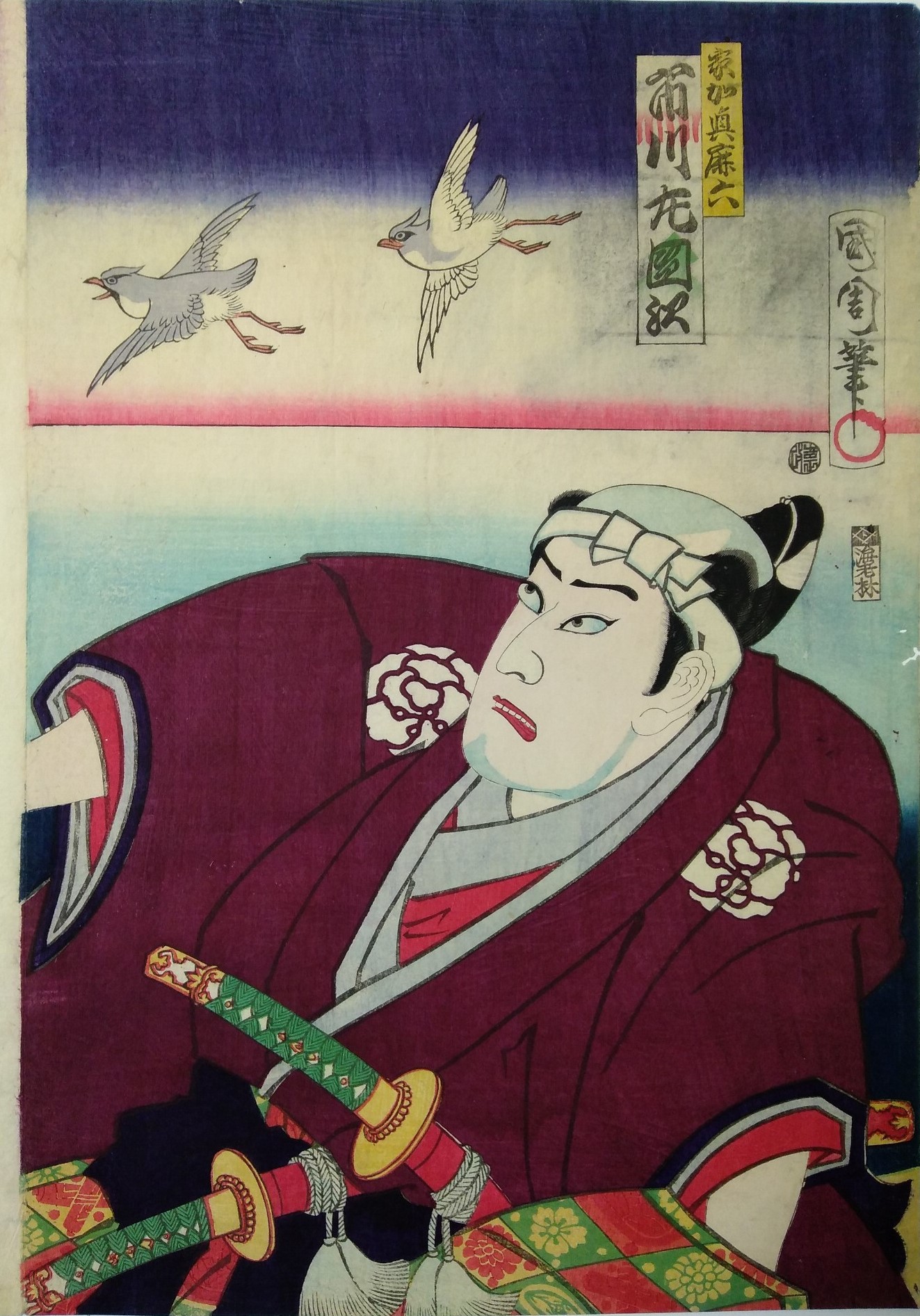
Kawaharasaki Kennosuke VII as Ogata Jiraya from the Kabuki drama Hōraisan Soga no kaomise, which was performed for the first time at the Morita za theatre of Tōkyō.
USD$ 233.00
Ichikawa Sadanji as Yaka (or Kaka) Maasa from the Kabuki drama Hōraisan Soga no kaomise, which was performed for the first time at the Morita za theatre of Tōkyō.
USD$ 233.00
 Sold Out.
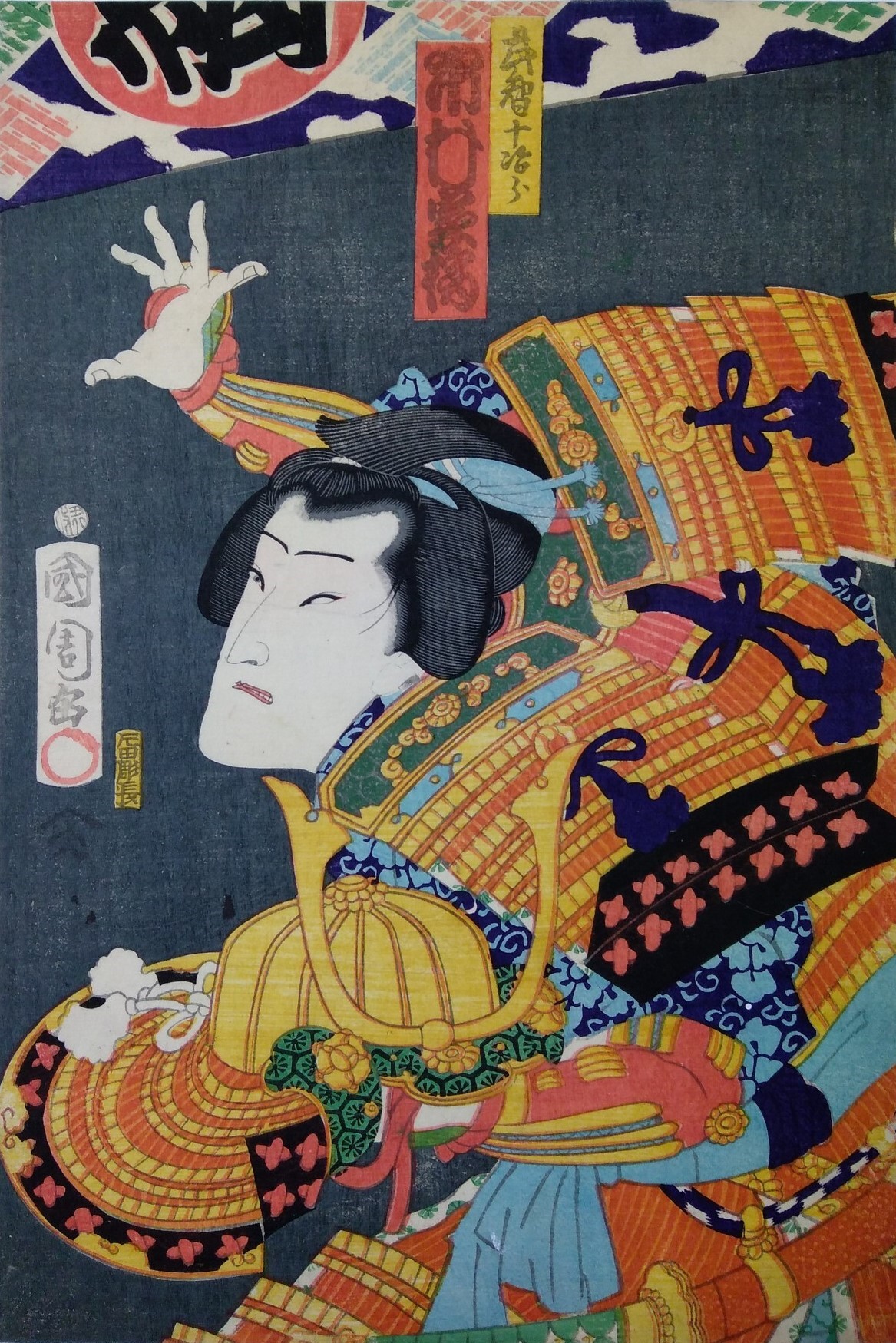
The subject of this print is Takechi Jūjirō, a fictional character from the Taikōki, an historical novel based on the biography of Toyotomi Hideyoshi.
Hideyoshi (preceded by Oda Nobunaga and followed by Tokugawa Ieyasu) has been a pivotal figure for the Japanese unification process which followed the warring states period (sengoku jidai, 1467 ~ 1615).
In the novel Jūjirō is the son of Takechi Mitsuhide, whose character is shaped on the image of Akechi Mitsuhide, Nobunaga`s retainers and responsible of his own master`s death during an ambush set at the
Honnō ji temple when this was set afire.
After Nobunaga`s death he tried to establish himself as Shōgun, but was quickly pursued and defeated by Hideyoshi few days later.
Sold Out
 Sold Out.
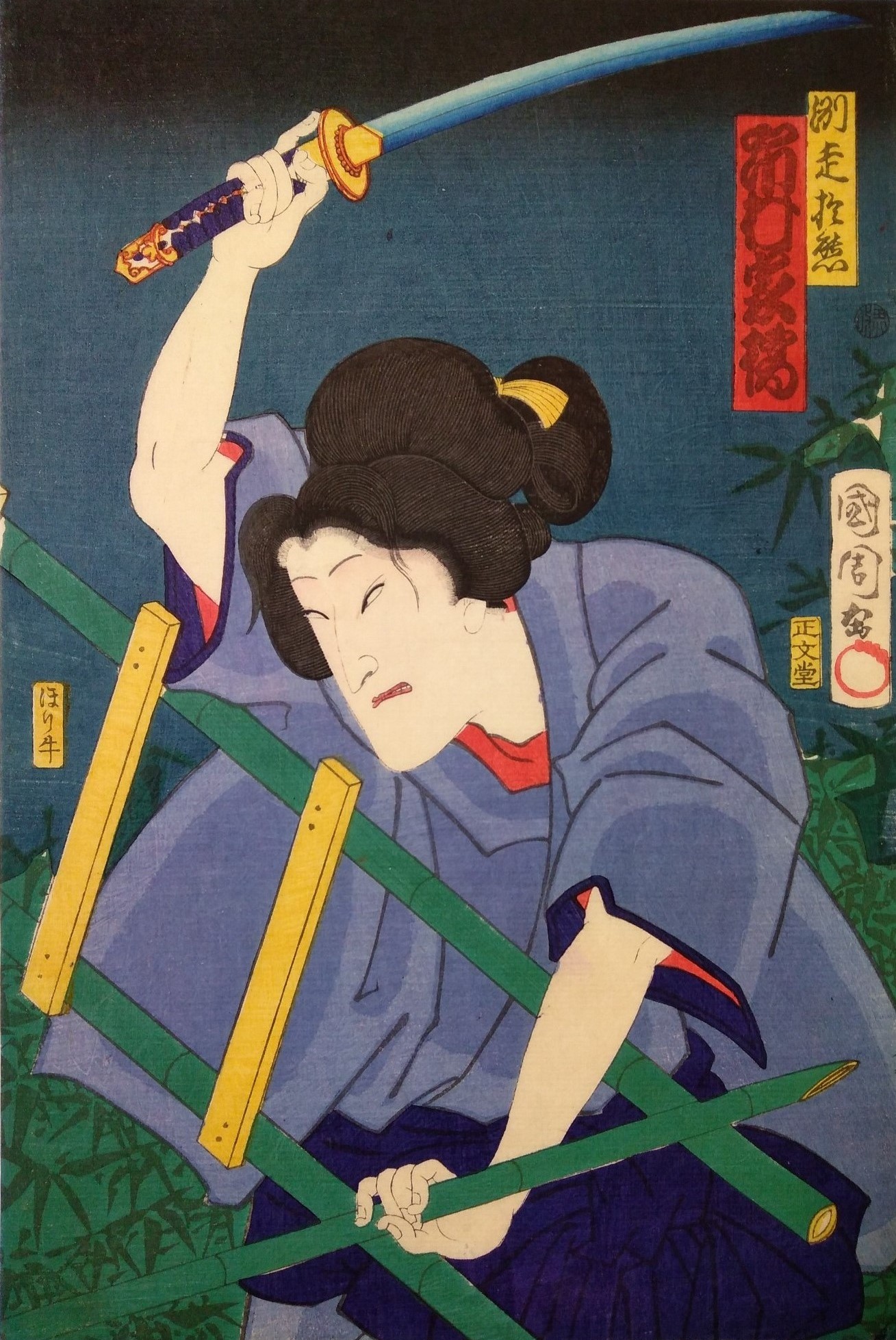
The kabuki actor Ichimura Kakitsu IV playing as onnagata the female role of Subashiri Okuma.
She appears in the kabuki drama Musume Hyōban Zenaku Kagami as one of the "five women of the five waves" (shiranami gonin onna), the female version of a group of thieves known as
"The five men of the five waves" (shiragami gonin otoko).
The play was written by Kawatake Mokuami and performed for the first time in August 1865 at the Ichimura Za of Edo.
Sold Out
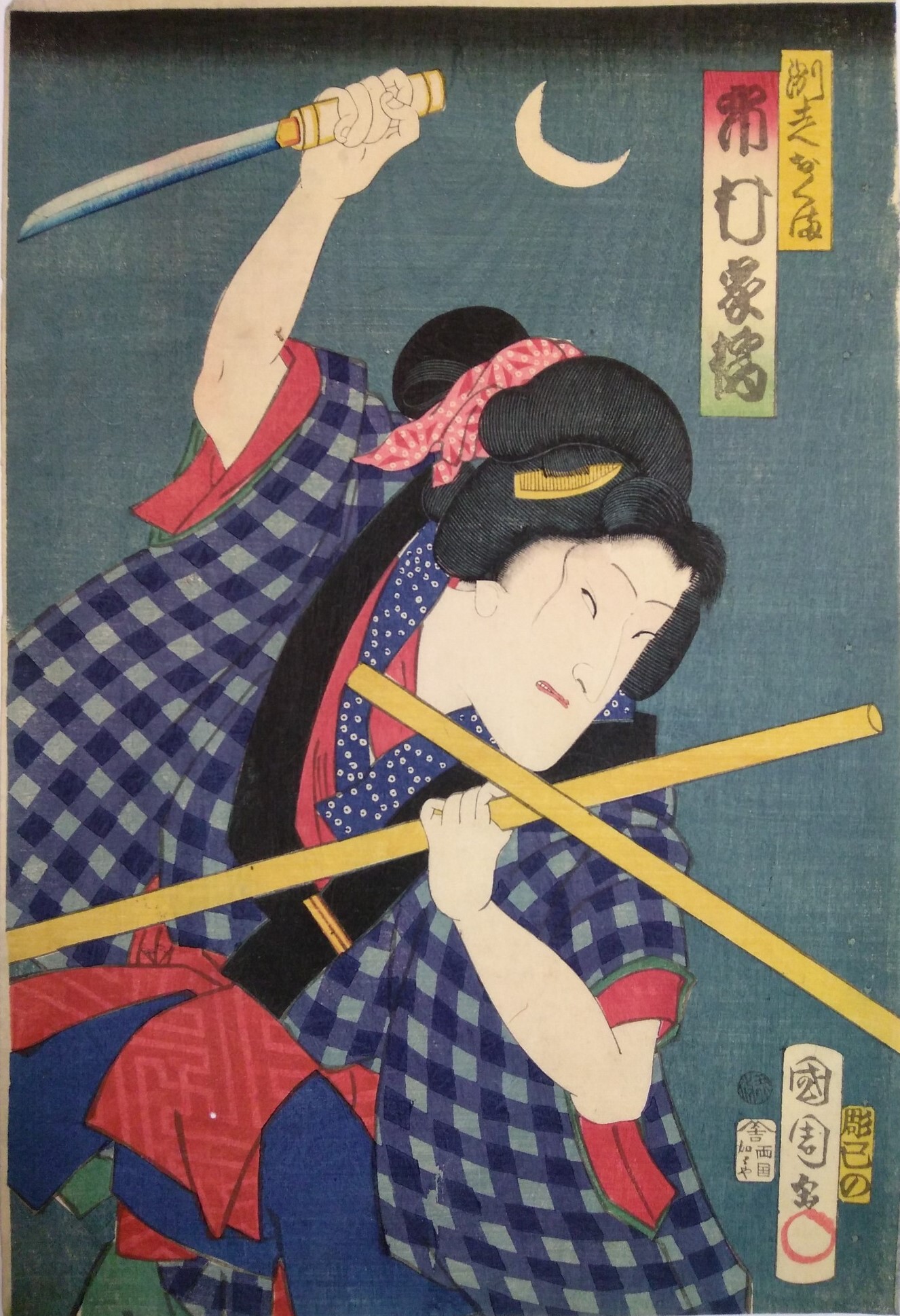
The kabuki actor Ichimura Kakitsu IV playing as onnagata the female role of Subashiri Okuma.
She appears in the kabuki drama Musume Hyōban Zenaku Kagami as one of the "five women of the five waves" (shiranami gonin onna), the female version of a group of thieves known as
"The five men of the five waves" (shiragami gonin otoko).
The play was written by Kawatake Mokuami and performed for the first time in August 1865 at the Ichimura Za of Edo.
USD$ 112.00
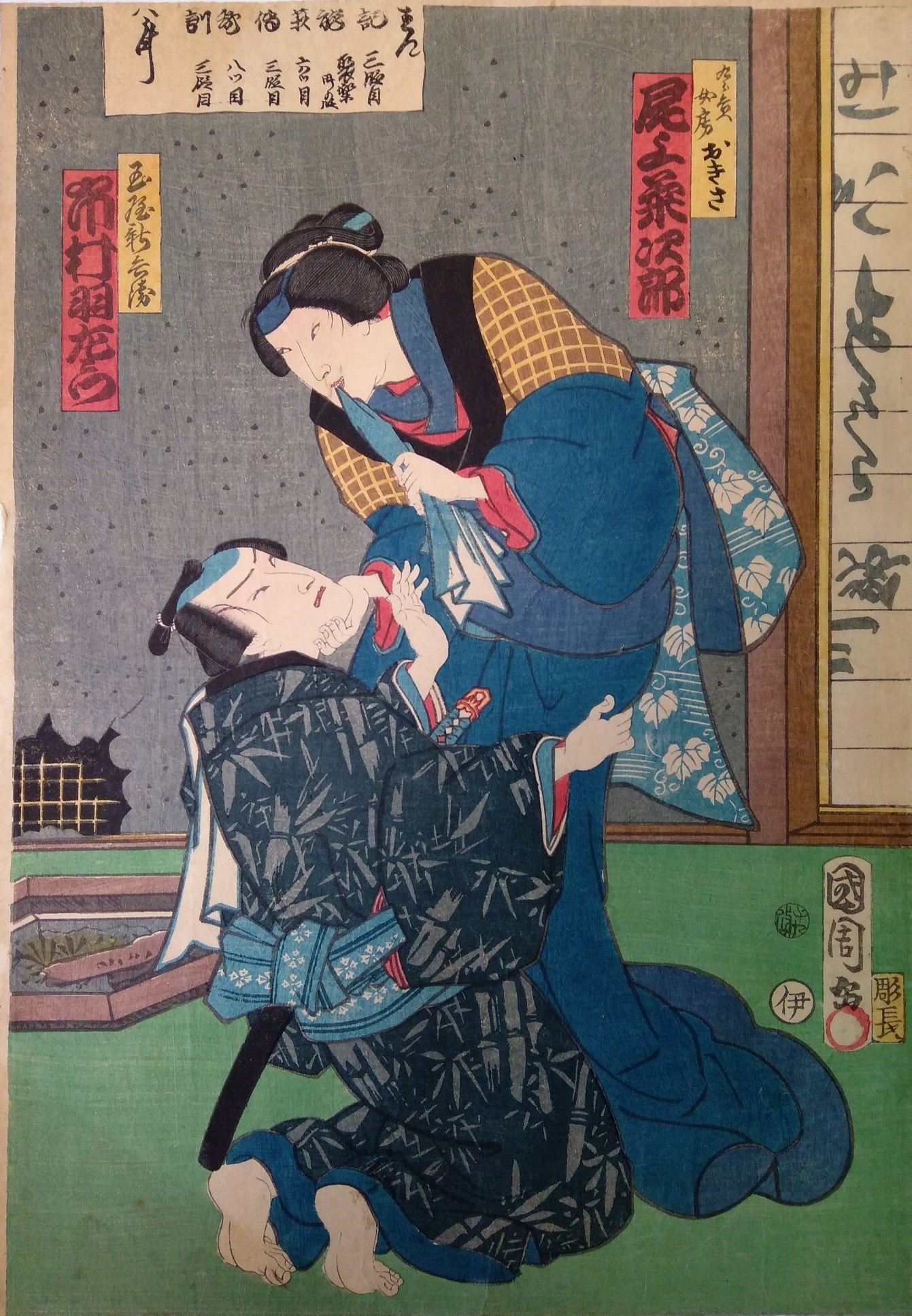
Central print from a triptych. A tense domestic moment from "Asaki En Giri no Shigarami": the outcaste`s wife Okisa bends over the kneeling samurai Tamaya Shinbei, fanning his face in anguished concern. Kunichika captures the drama with rich indigo robes against a speckled night sky, using bold pattern contrasts to heighten emotion.
USD$ 137.00
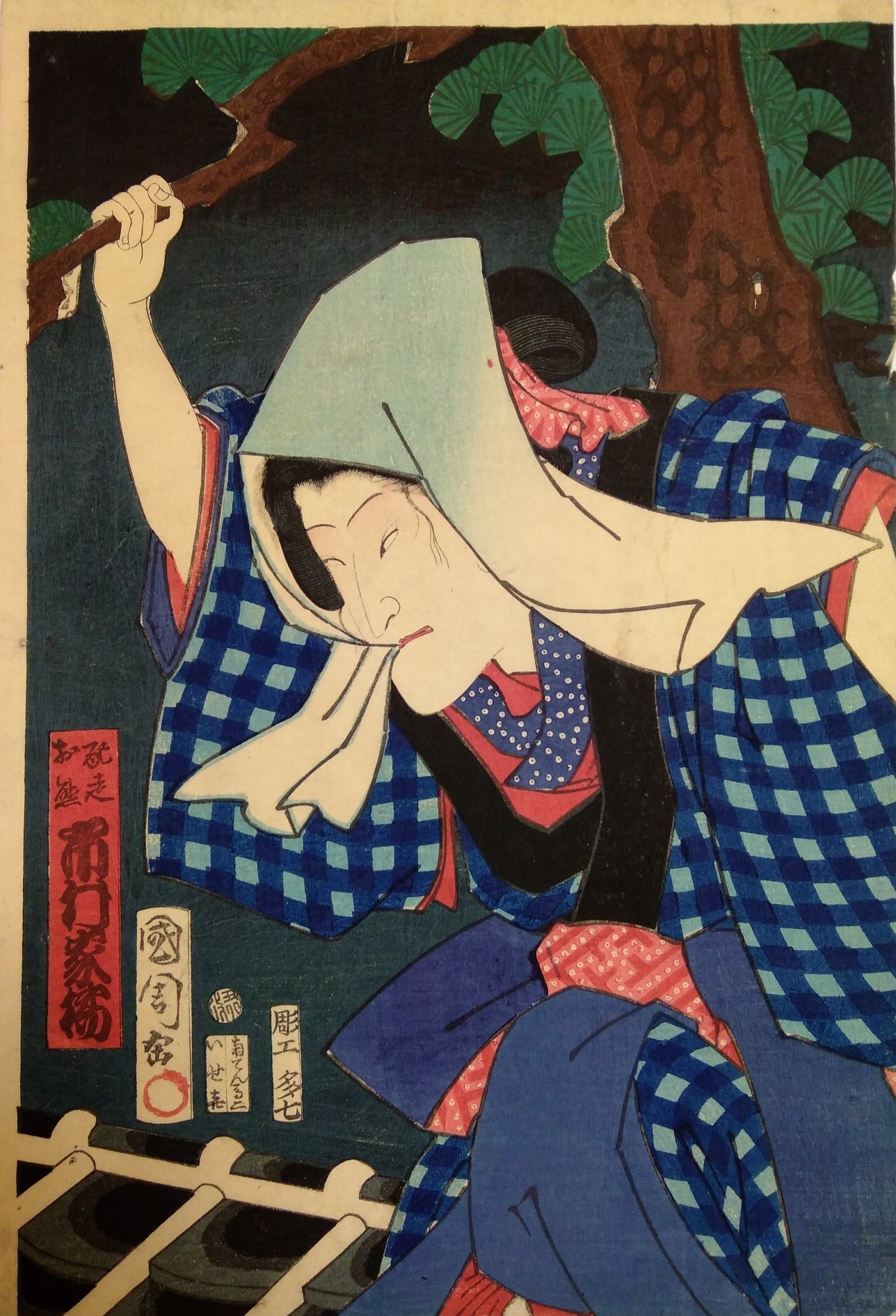
The kabuki actor Ichimura Kakitsu IV playing as onnagata the female role of Subashiri Okuma.
She appears in the kabuki drama Musume Hyōban Zenaku Kagami as one of the "five women of the five waves" (shiranami gonin onna), the female version of a group of thieves known as
"The five men of the five waves" (shiragami gonin otoko).
The play was written by Kawatake Mokuami and performed for the first time in August 1865 at the Ichimura Za of Edo.
USD$ 118.00
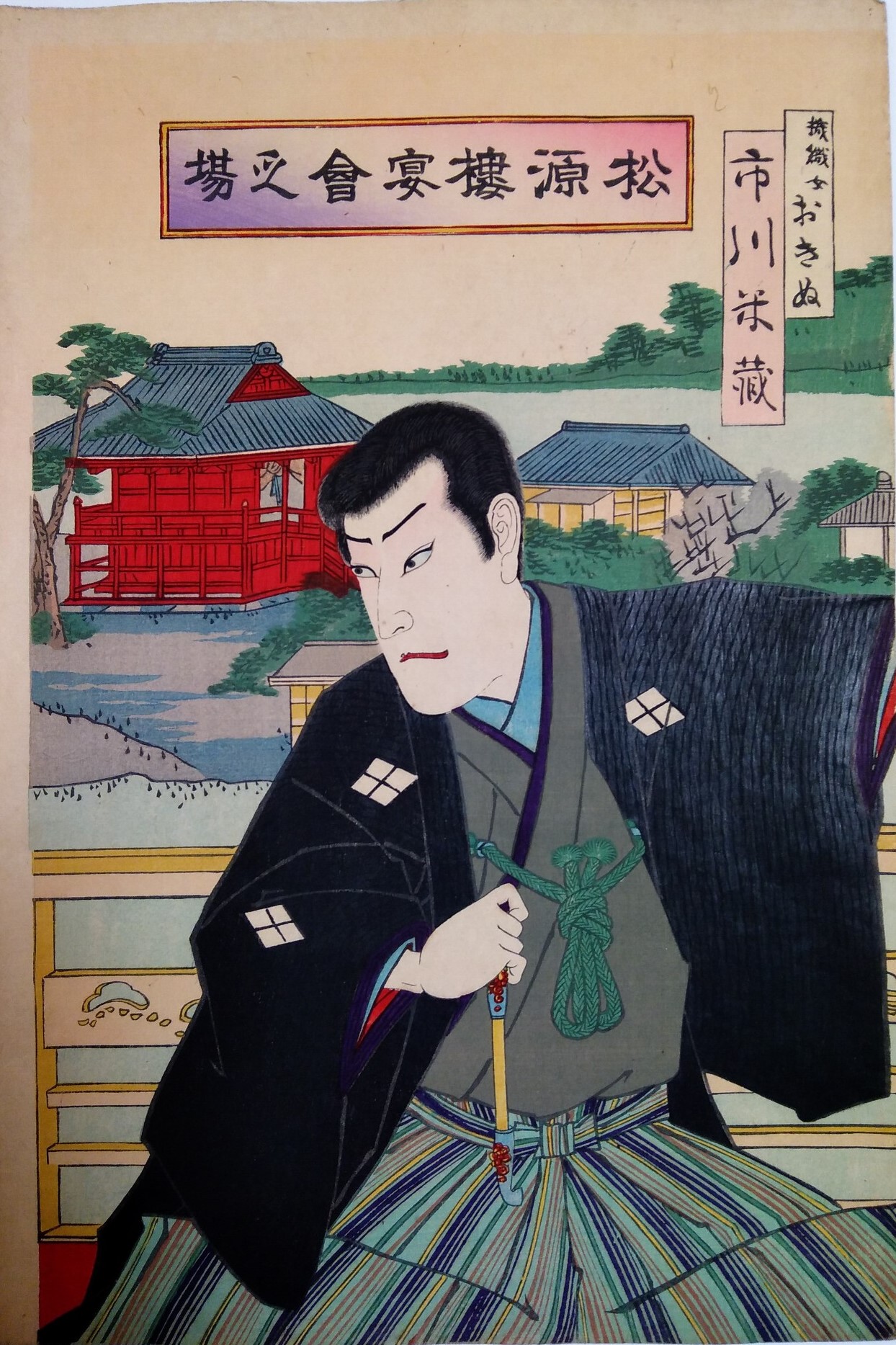 Sold Out.
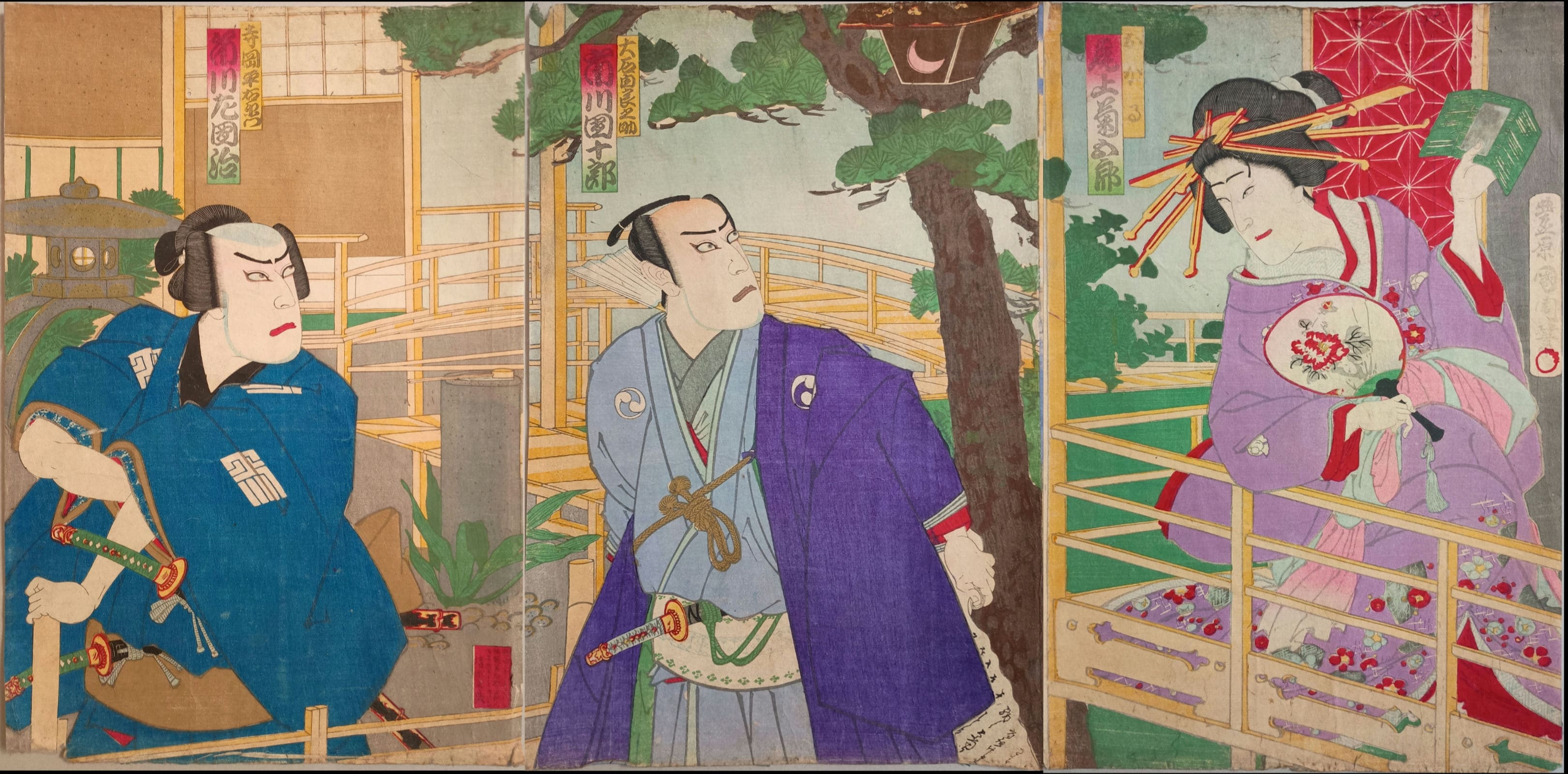
Central print from a triptych by Toyohara Kunichira.
In this works the author sign appears as "responding to a demand Toyohara Kunichika" (ōjun Toyohara Kunichika, 応需豊原国周), perhaps showing the great amount of work the artist was commissioned by the time.
The play in queston is "Orihime shusu enishi no iroito"., performed for the first time in Tōkyō, at the Meiji Theater (Meiji za) in 1894.
Sold Out.
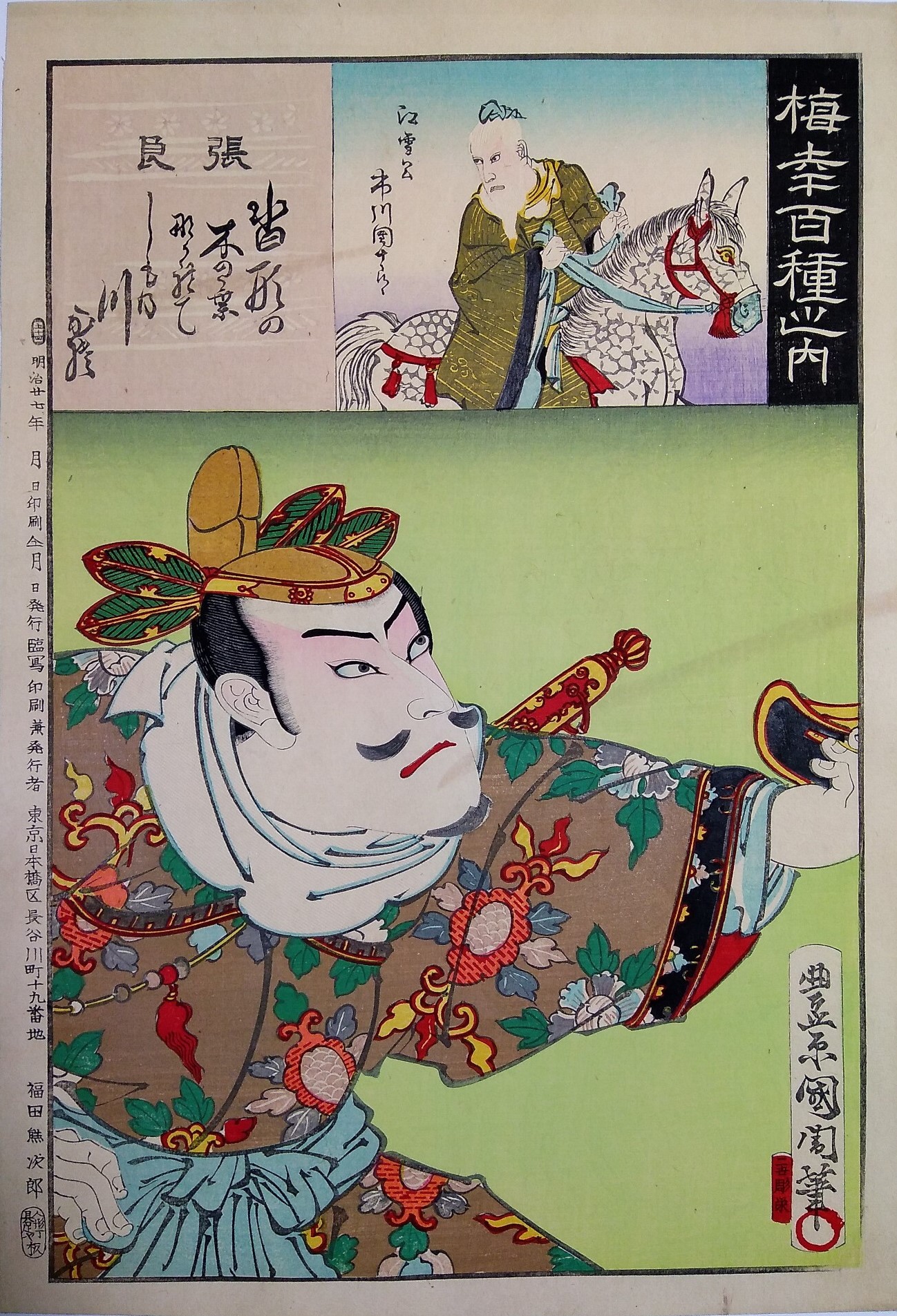
Kunichika`s print from the "One hundred roles of Baikō", a colletion which portraits the kabuki actor Onoe Kikugorō in one hundred different roles.
The historical character represented here is Chōryō, also know as Zhang Liang, a Chinese politician and military strategist lived between the 3rd and 2nd century BC.
He is mainly remembered for having contributed to the establishment of the Han Dinasty and for his involvement in the assassination attempt of the first Emperor Qin Shi Huang.
Descendend from an aristocrat family, he was born in Xinzheng town, the capital of the Hán state, one of the seven major Chinese state by the time, which in 230 BC was conquered and annexed to the Qin state.
As an act of revenge he tried killing the Emperor Qin Shi Huang hiring an assassin. He planned and ambush and had a massive iron hammer forged for the man, so that he could have thrown it crashing the Emperor
carriage killing him. He eventually failed and Zhang Liang found himself with no other choice but run away keep living as a fugitive.
USD$ 221.00
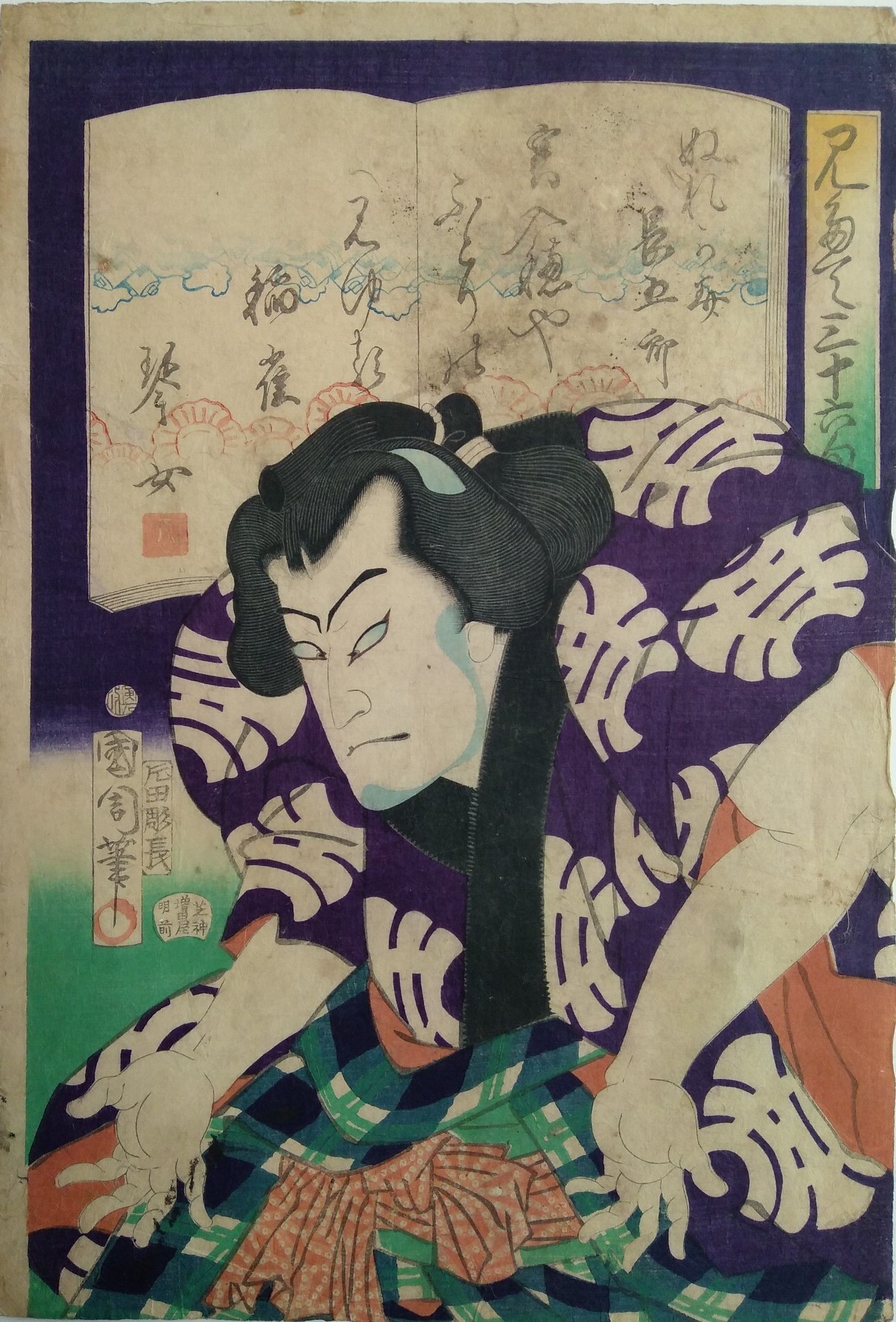
Nuregami Chōgorō is a fictional character from a jōruri (or a kabuki) drama from the Edo era, which is probably inspired by a sumō wrestler lived on the first half of the 18th century.
Chōgorō was the son of a rōnin (浪人) named Tōkura Yosobei. Passionate and naturally talented in sumō he was adopted by the wrestler Araishi Onoemon and, as his disciple, he took the name of Araishi Chōgorō.
Due to his youth and his hot temperament it wasn`t uncommon for him to get involved in quarrels or fightings so that for avoiding to be heavily injured he started covering his forehead with wet paper, which is compact,
resistent and difficult to scratch. This beahviour had him to gain the nickname of "nuregami" or "wet paper".
Eventually he`ll end up with killing a samurai named Hatoribe (or Hattori) Sozaemon and with being arrested after having taken shelter in his hometown Hachiman.
USD$ 144.00
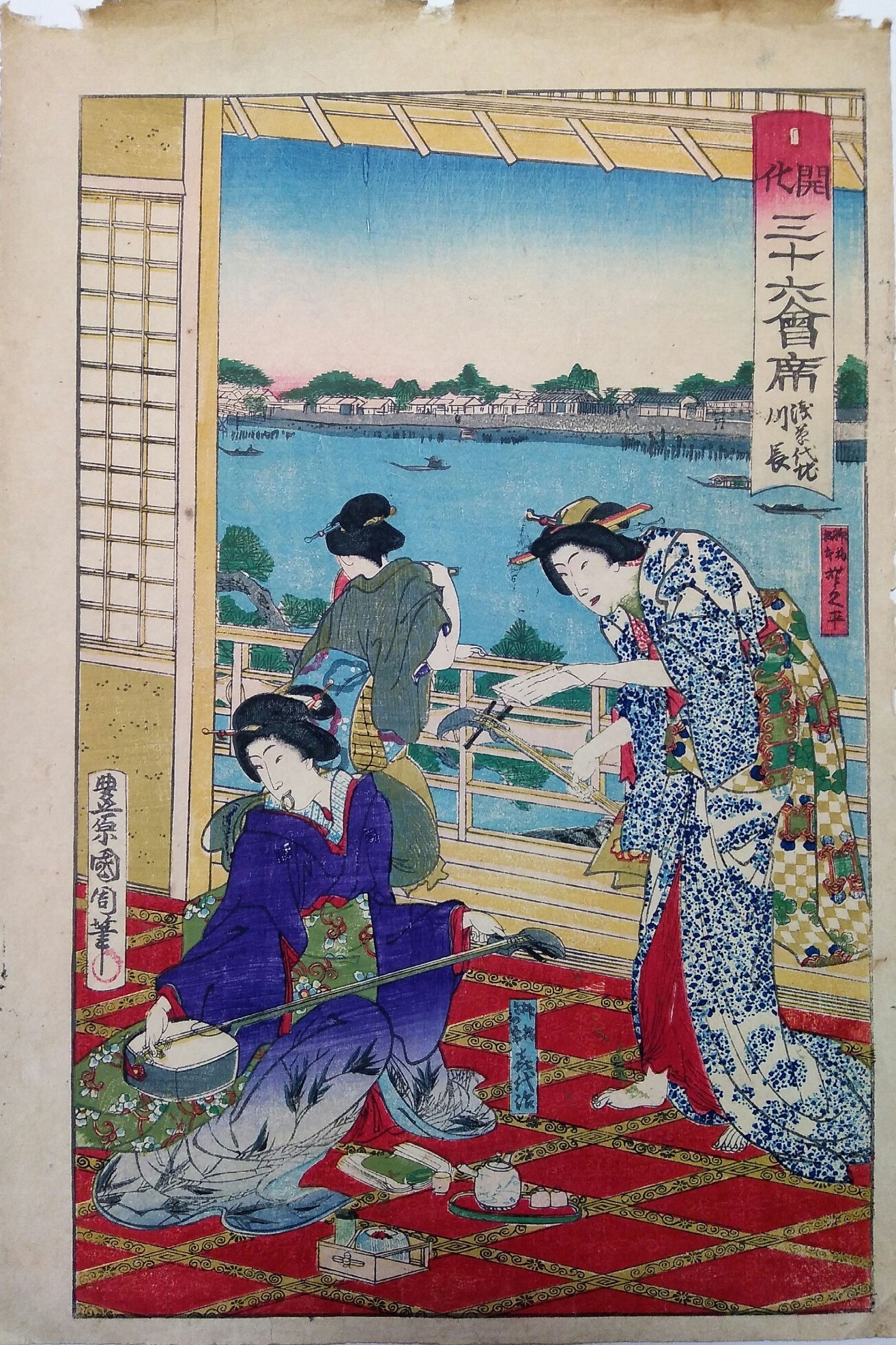
From the series "Thirty-six Famous Restaurants" by Kunichika, a glimpse of an interior room at the Kawaosa restaurant, overlooking the Sumida River, in Asakusa.
Inside, three women are getting ready to entertain the upcoming customers, tuning their instruments and rehearsing some poetic verses or songs.
USD$ 174.00
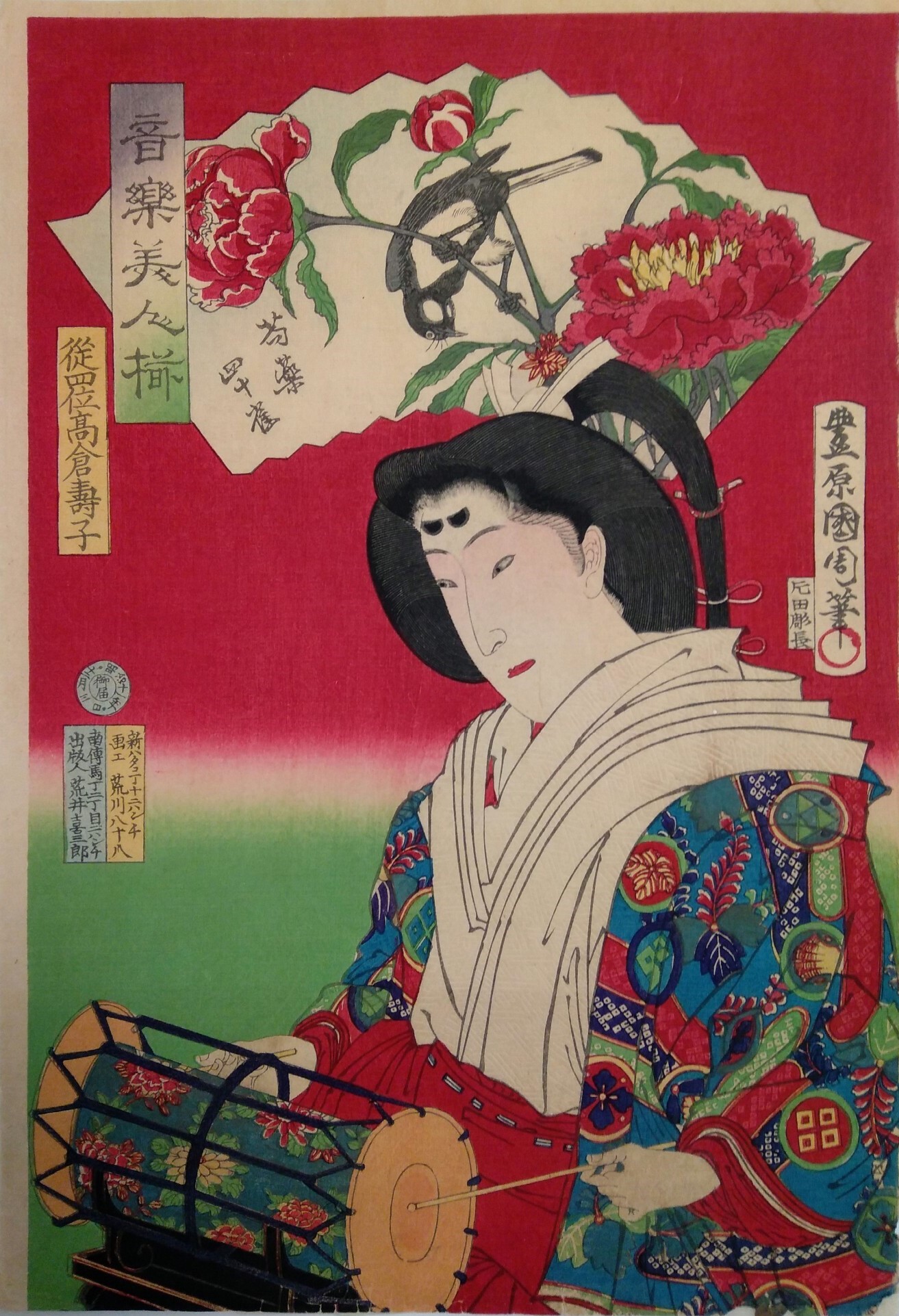
Born in 1840 and deceased on January 27, 1930, Takakura Kazuko, known at court as Shinju, was a distinguished noblewoman during the Meiji and Taishō periods.
Originating from the aristocratic Takakura family, she served the Grand Minister of the Left, Ichijō Tadaka. In 1868, as Yoshiko, Tadaka`s third daughter and the future Empress
Shōken, entered the court as the consort of Emperor Meiji, Kazuko was appointed to accompany the new consort, taking on the role of a court lady. Later, she was promoted to head
of the court ladies, managing communications between the Major of the Imperial Palace and the Empress and participating in all official outings.
Following the Empress`s death, Kazuko retired to the city of Kyoto in 1915, where she remained until her death in 1930, at the age of 91.
USD$ 230.00
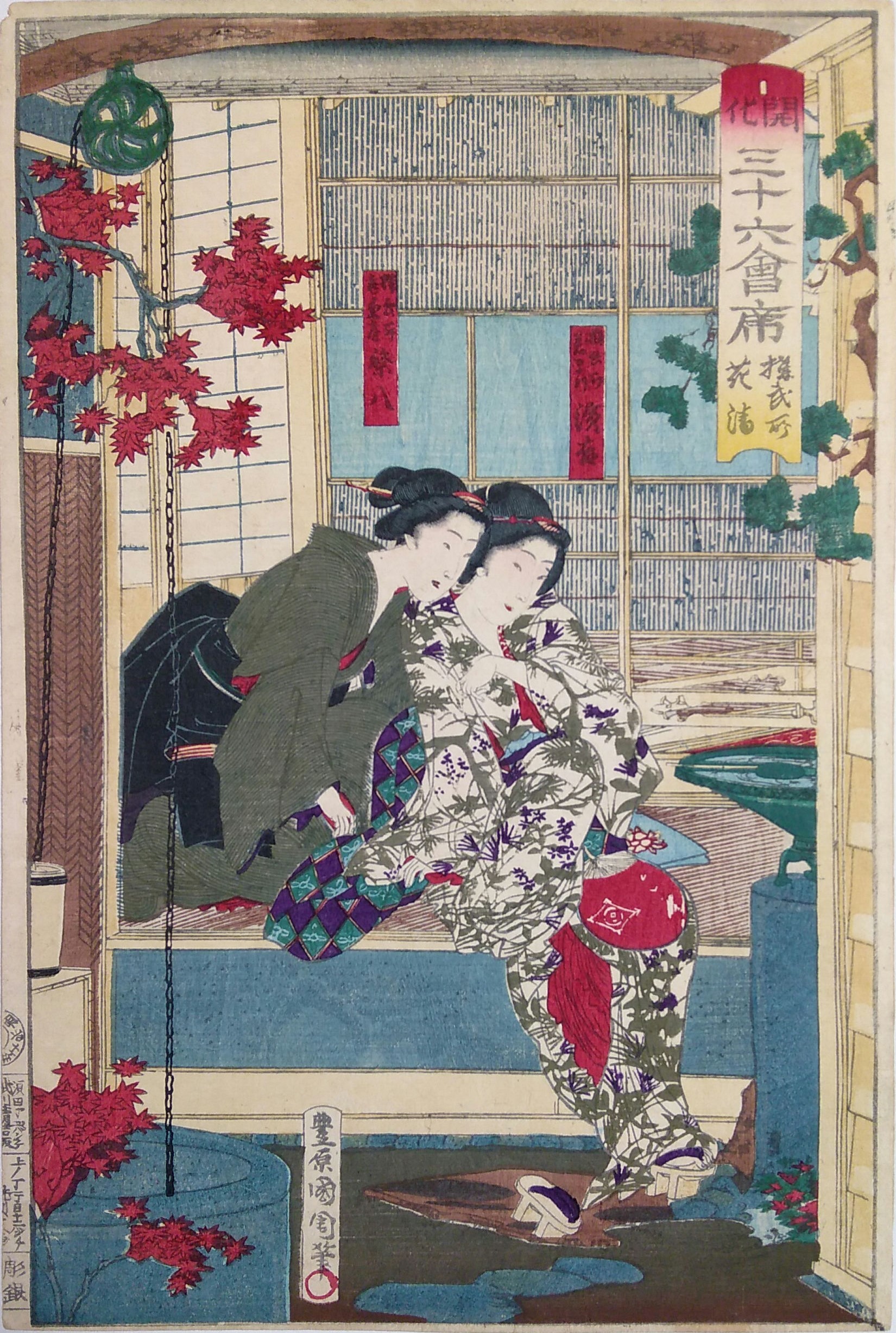
This print by Toyohara Kunichika, part of the "Thirty-six Famous Restaurants" series, depicts two women (Hamakichi on the right and Saihachi on the left) inside Hanakiyo restaurant in Kobusho. The women, elegantly attired in traditional kimonos, are portrayed in a moment of intimate conversation, set against a richly detailed background that captures the essence of a refined place.
USD$ 165.00
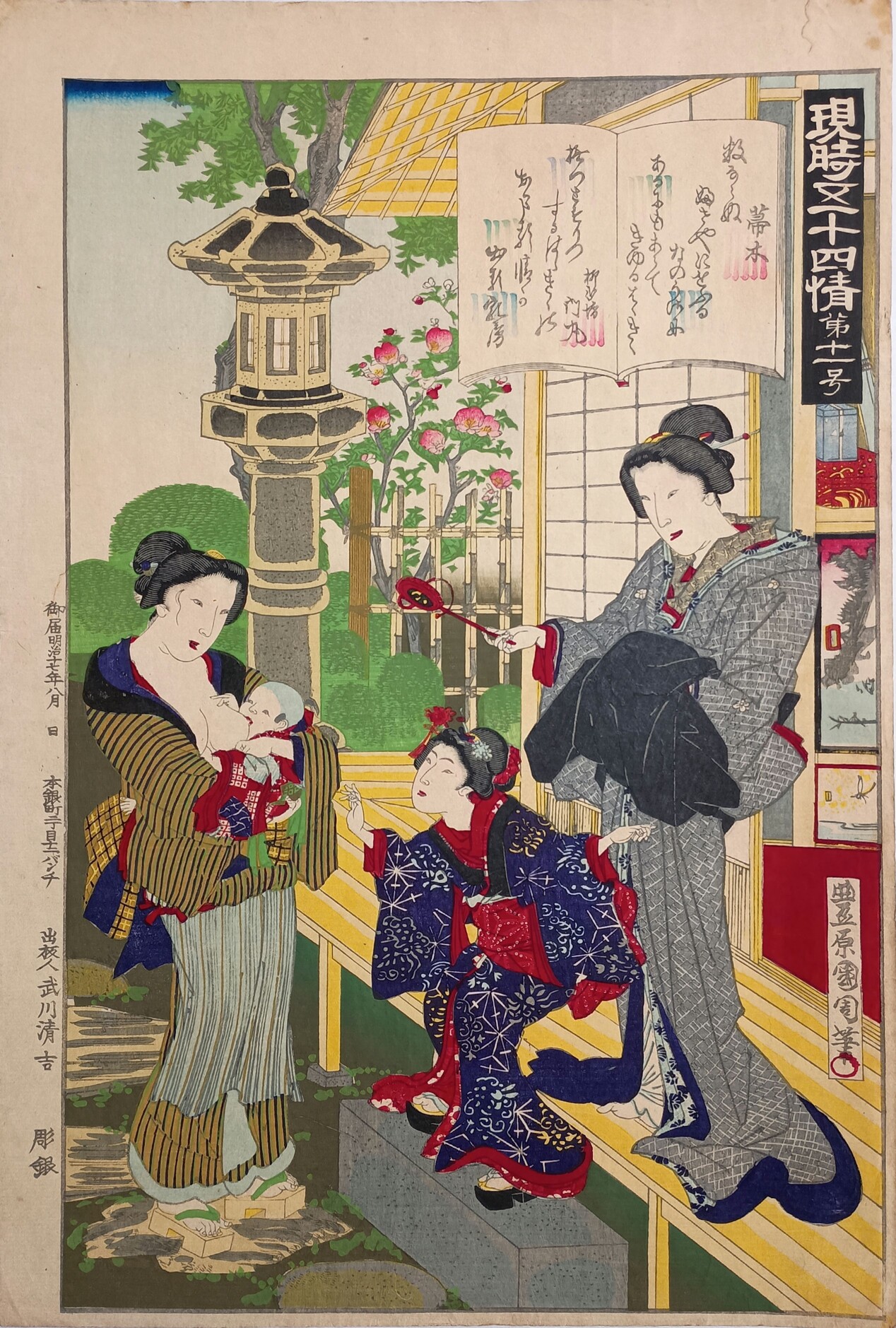
Kunichika`s "Fifty-four Modern Feelings" reimagines the chapters of The Tale of Genji, adapting them to Meiji society.
"Hahakigi" is the second chapter of The Tale of Genji and portrays Hikaru Genji`s encounter with Utsusemi, a lower-ranking court lady. Though
already married, she resists Genji`s advances and ultimately evades him, symbolizing unattainable love and social disparity. The chapter also
explores Genji`s admiration for Fujitsubo and his struggles with his wife Aoi.
USD$ 253.00