Mizuno Toshikata
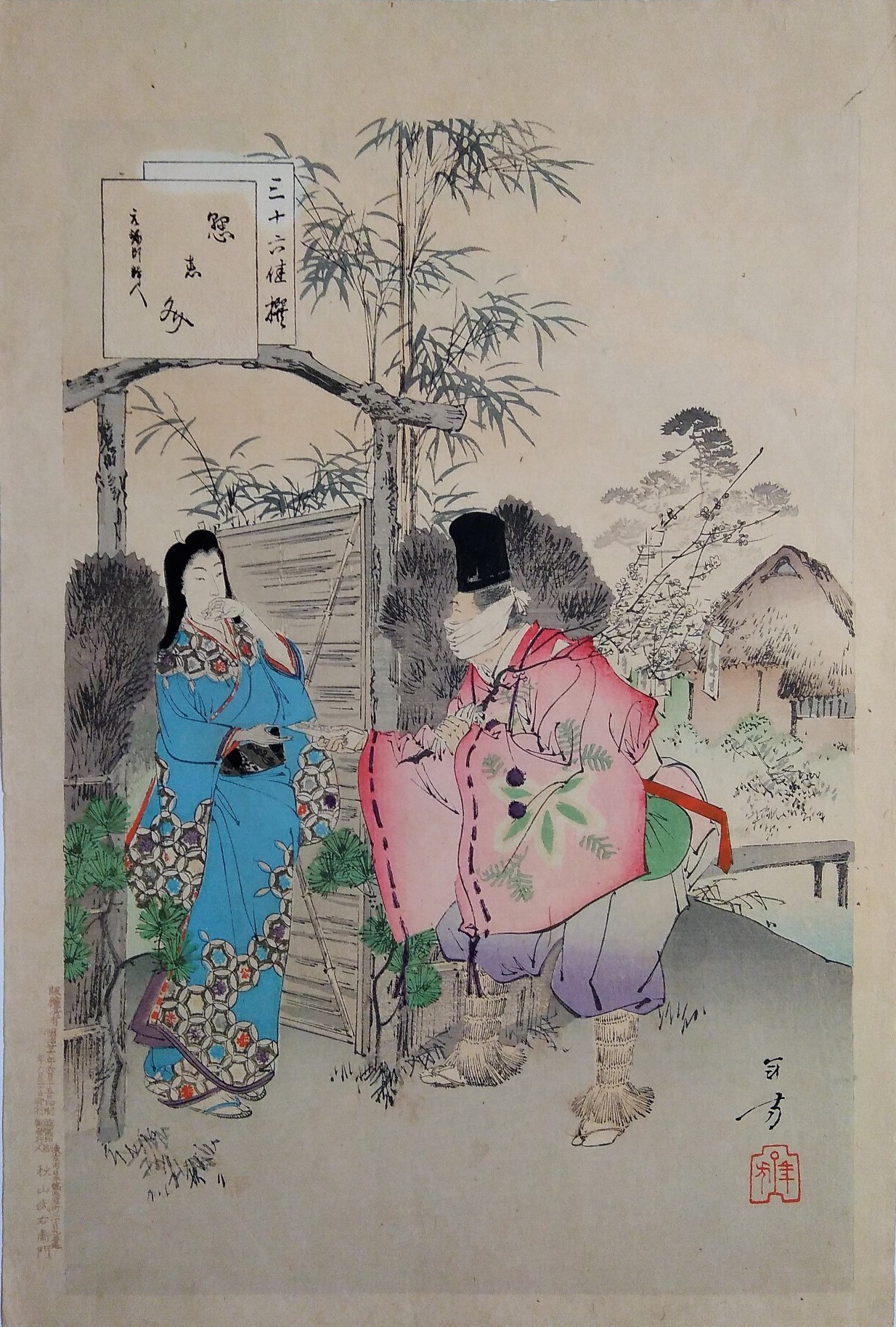
1866 ~ 1908Mizuno Toshikata, born Nonaka Kumejirō in the Kanda district of Edo in 1866, was a Japanese print artist, illustrator, and nihonga painter whose career reflects the transition from late ukiyo-e to modern Japanese art.
The son of a master plasterer, he entered the studio of Tsukioka Yoshitoshi in 1879, at the age of thirteen. His training was interrupted for a time, reportedly because his father disapproved of Yoshitoshi`s unconventional behaviour.
During this period, Toshikata studied ceramic decoration and explored other pictorial traditions, including nanga and flower-and-bird painting, before returning to Yoshitoshi`s circle.
In 1887, on Yoshitoshi`s recommendation, Toshikata began working as an illustrator for the Yamato Shinbun. He subsequently produced numerous illustrations and kuchi-e frontispieces for newspapers, literary magazines, and novels, including
publications such as Miyako no Hana and Shinshōsetsu. During the First Sino-Japanese War of 1894-1895, he also designed numerous sensō-e depicting military events. His woodblock prints encompassed historical subjects, warriors, contemporary
customs, and especially bijin-ga. Among his best-known works is the series Thirty-six Selected Beauties (Sanjūroku kasen), which presents women from different periods of Japanese history.
Toshikata also participated in the developing institutions of modern Japanese painting. Recognized by Okakura Tenshin, he joined the Japan Youth Painting Association and became a supporting member of the Japan Art Institute when it was founded in 1898.
His pupils included Kaburaki Kiyokata, Ikeda Terukata, Ikeda Shōen, and Arai Kanpō. Through Kiyokata (who later trained Itō Shinsui and Kawase Hasui) Toshikata`s artistic lineage also contributed indirectly to the development of the shin-hanga movement.
Mizuno Toshikata died on 7 April 1908, at the age of forty-two, reportedly after collapsing from exhaustion; a contemporary account attributed his death to heart failure brought on by nervous overwork. Although his career was relatively short, his work and
teaching helped transmit the techniques and visual culture of ukiyo-e into the emerging world of modern Japanese painting and illustration.
 Not for Sale
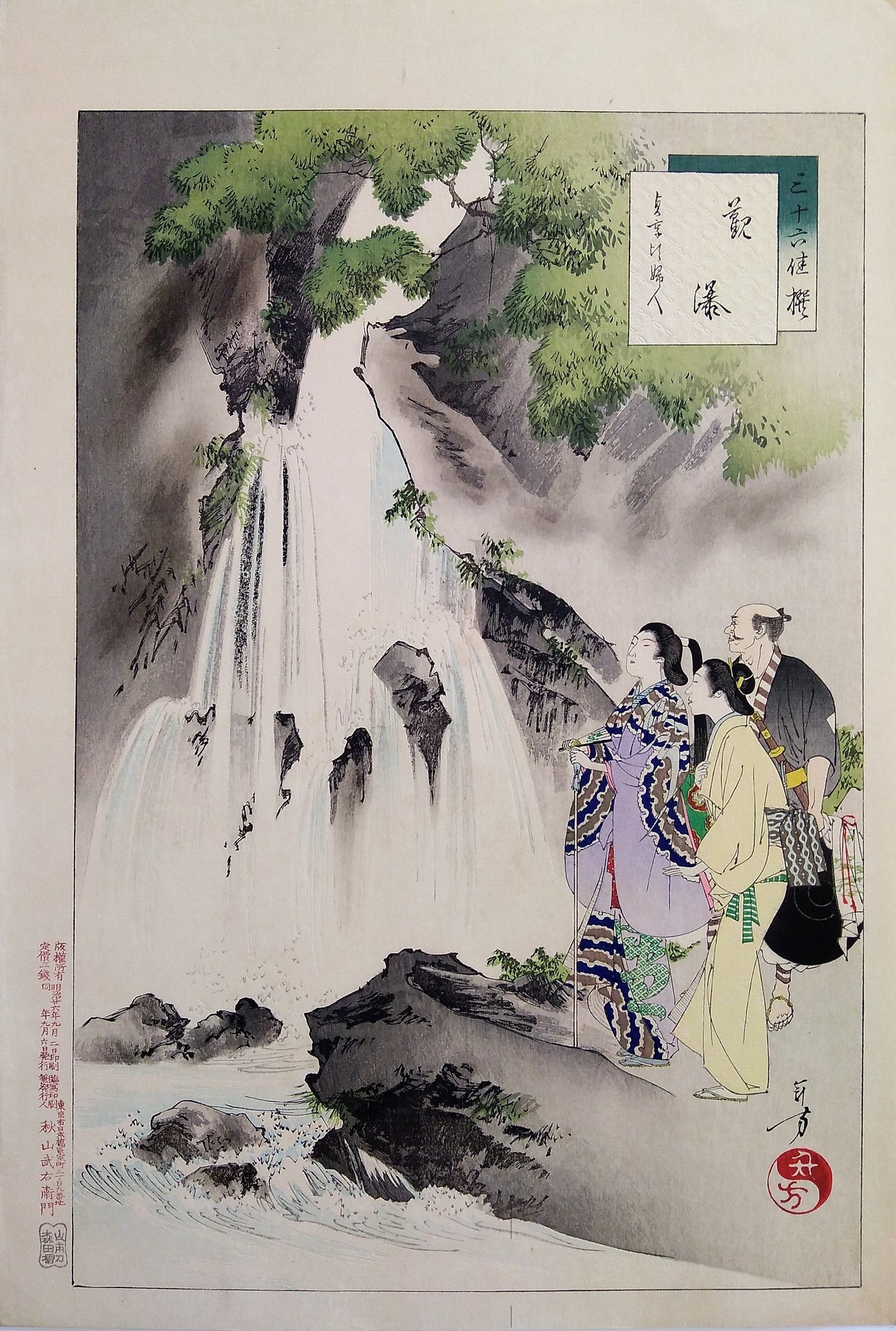
This print by Mizuno Toshikata presents a traditional Japanese landscape, depicting a serene and picturesque scene of a 17th-century warrior and a noble woman, accompanied by her chaperone wearing a yellow yukata,
as they enjoy the view of a waterfall on a summer day.
Known for his style that marks the transition from ukiyo-e to the shin-hanga movement, Toshikata captures the essence of the natural landscape with a touch of delicacy and realism. The artwork portrays the tranquility and picturesque
beauty of the visitors admiring the cascading waters, effectively blending traditional and modern artistic elements.