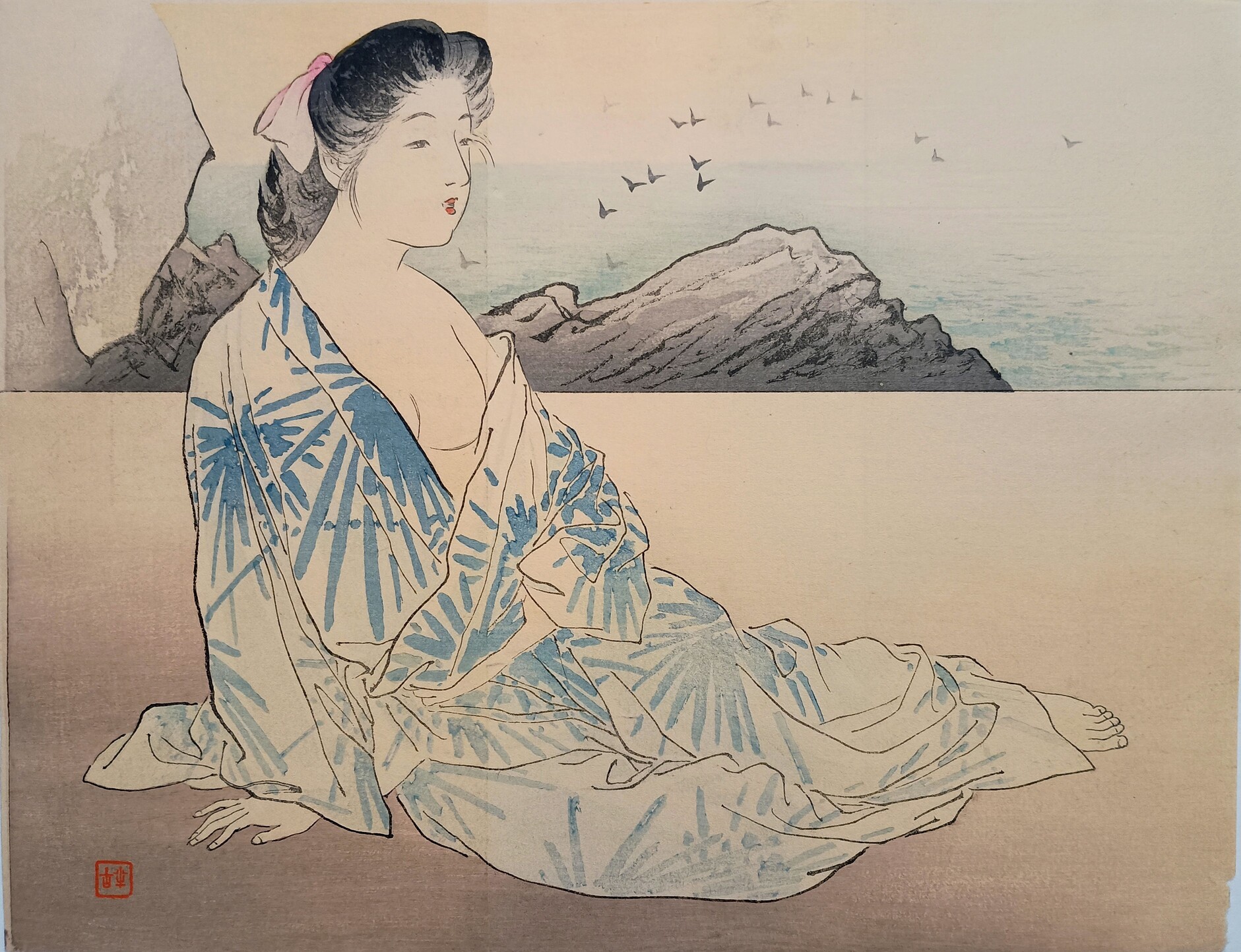
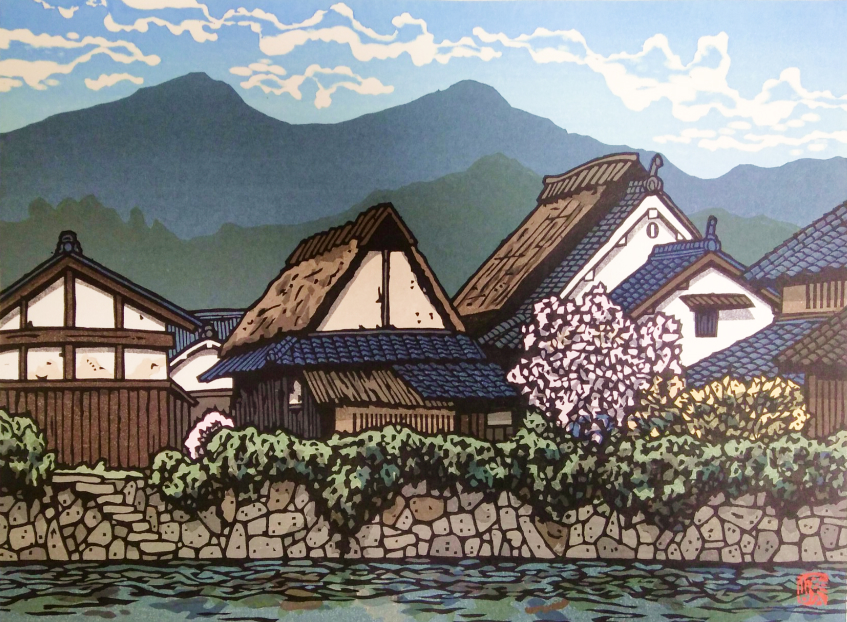
Kajita Hanko
1870 ~ 1917Kajita Hanko, born Jojirō Kajita in Tokyo, was a Japanese Nihonga painter, illustrator, and print designer whose career bridged the world of traditional Japanese print culture and modern Meiji-period illustration.
The son of a distinguished metal engraver, he initially studied Shijō-style painting under Nabeta Gyokuei, who gave him the artistic name Gyokushū. Following an eye illness that interrupted his studies, he continued his artistic training
under the Nanga painter Ishii Kenkō.
Although trained as a painter, Hanko became especially renowned for his illustrations, kuchi-e frontispieces, and newspaper work. In 1898 he briefly served as vice-principal of the Toyama Prefectural School of Arts and Crafts in Takaoka before
returning to Tokyo, where he founded a private art school and worked as an illustrator for the Yomiuri Shimbun.
His popularity grew through illustrations for widely read literary works, including Ozaki Kōyō`s Konjiki Yasha (The Demon of Gold), Tokutomi Roka`s Hototogisu, and Suehiro Tetchō`s Akukaze Koikaze (Evil Wind, Love Wind). He also produced numerous
kuchi-e for novels and magazines, becoming one of the most recognizable illustrators of the late Meiji period.
Beyond his success as an illustrator, Hanko played an important role as a teacher, mentoring future masters of Nihonga such as Kobayashi Kokei, Maeda Seison, and Okumura Togyū. He died of tuberculosis in 1917 at the age of forty-six. Today, his works
are preserved in major collections including the British Museum, the Metropolitan Museum of Art, the Minneapolis Institute of Art, and other international museums.
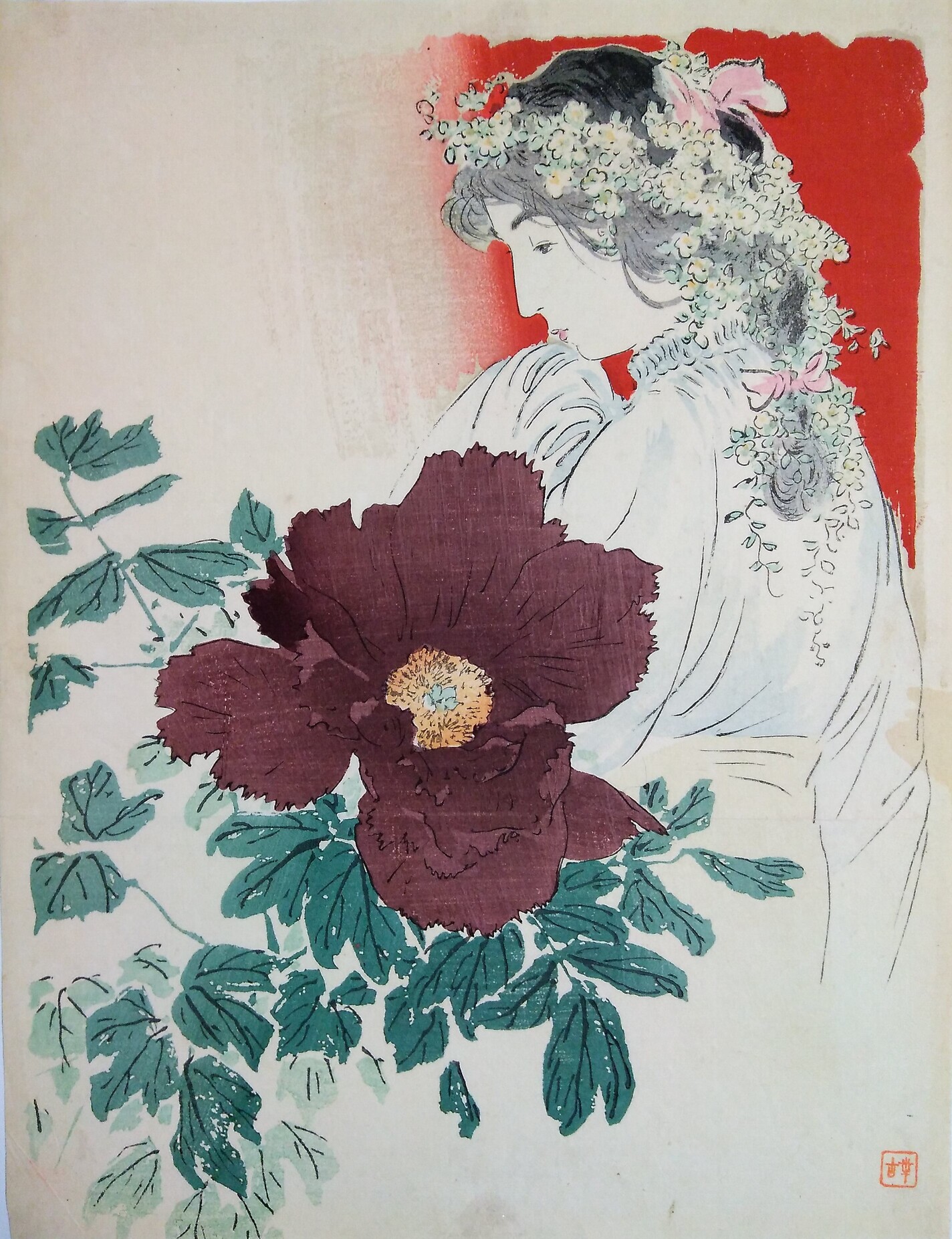
This print is an exquisite example of the kachō (flowers and birds) genre. It features a charming woman dressed in western attire, standing with her back turned towards a prominently displayed, fully blossomed peony in the foreground.
USD$ 269.00
 Not for Sale
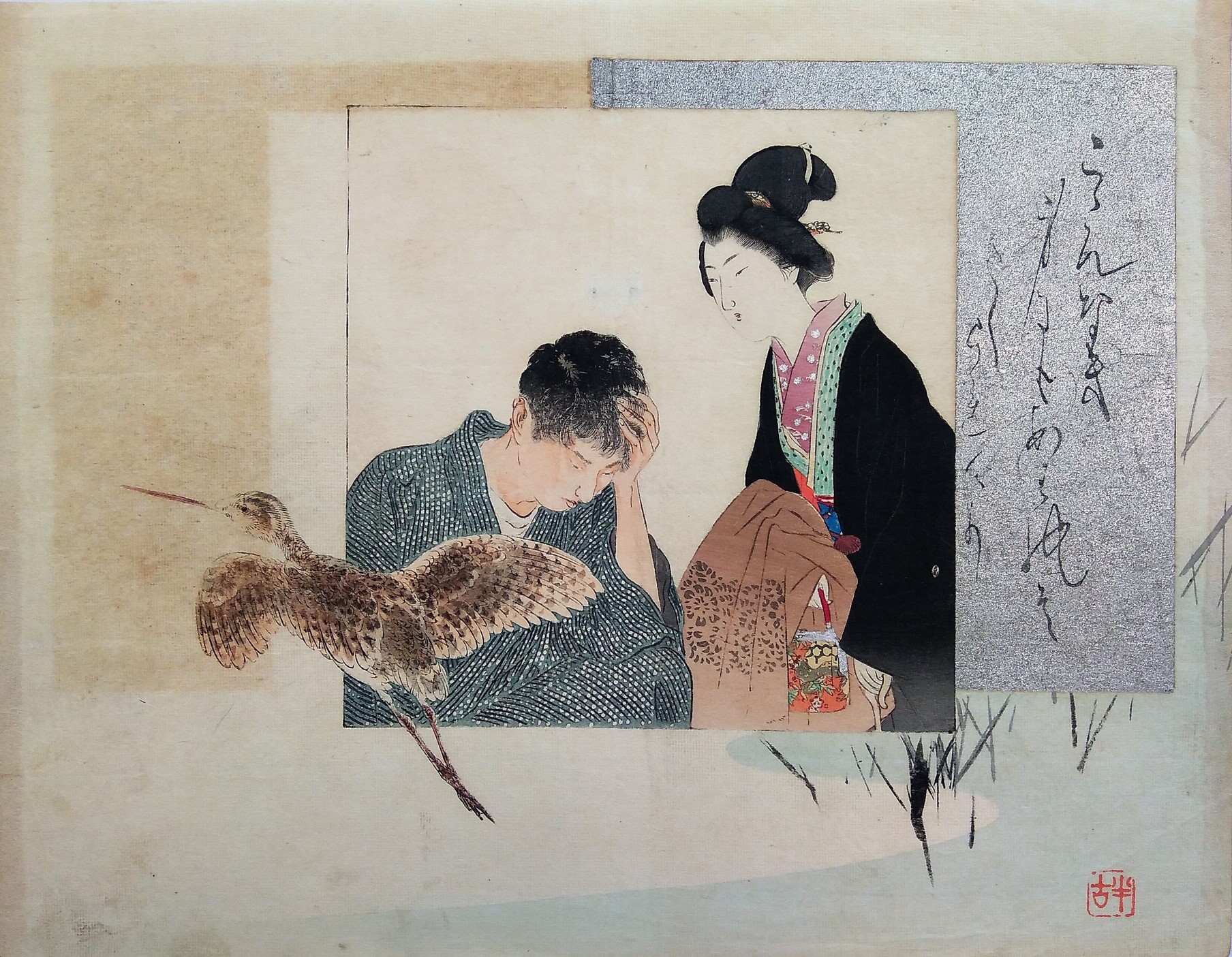
The man in the print is Murai Gensai, a Japanese novelist whose Hi no Dejima series featured Hanko`s print as a frontispiece.
In his youth, Murai was expected to join the Russian Studies Department at the Foreign Language Institute of Tōkyō, but due to illness, he moved to the United States.
After returning to Japan, he began working as a novelist for several newspapers, gaining fame with his novel Shokurakudō.
 Not for Sale
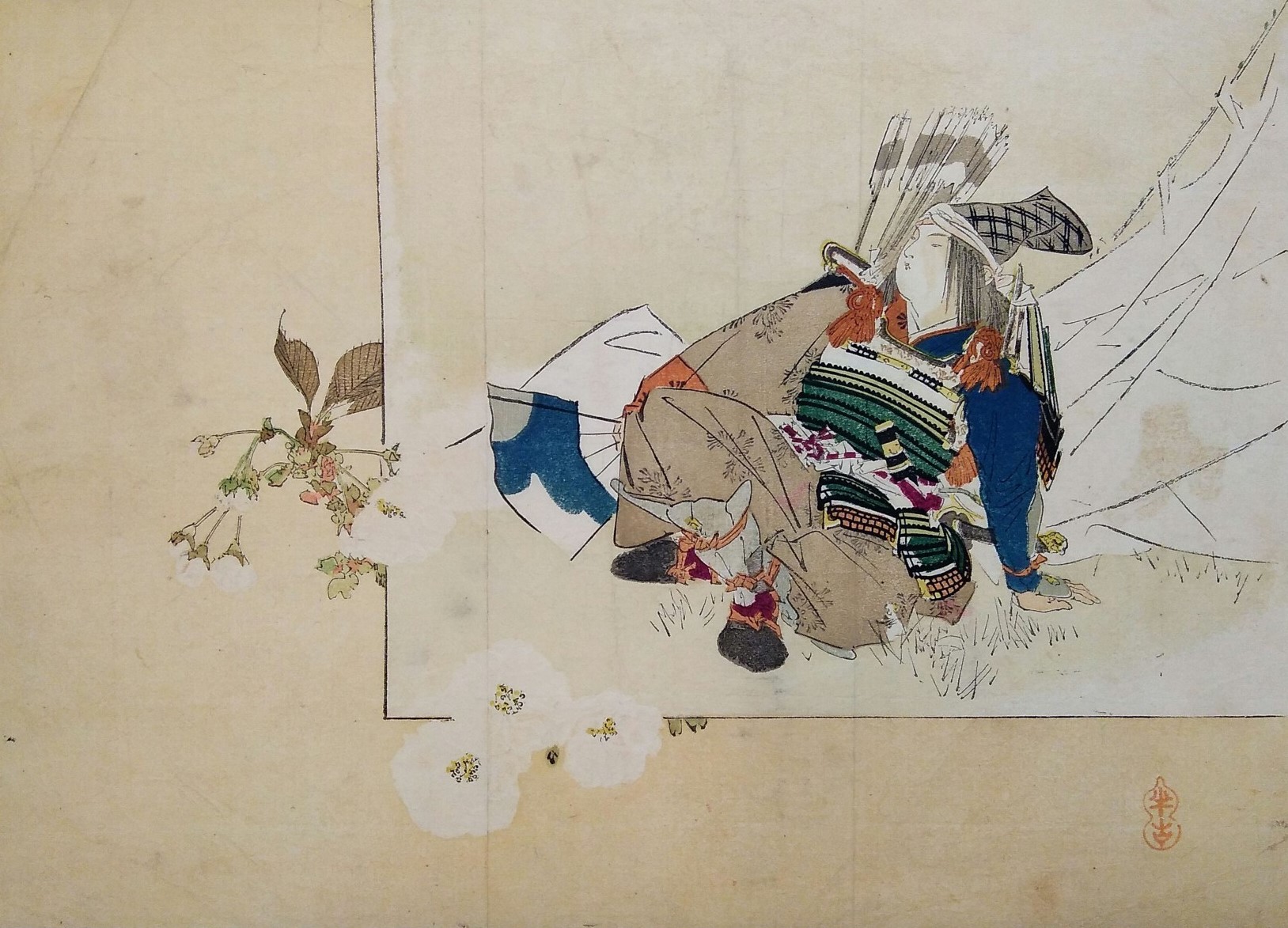
A print depicting a young warrior, likely Minamoto no Yoshitsune, in a moment of rest.
Born in 1159, Yoshitsune was the son of Minamoto no Yoshitomo, leader of the Minamoto clan, and Tokiwa Gozen. His youth was marked by conflict as the Minamoto clan sought to assert its power during the Heian period.
After losing his father and two brothers in the "Heiji Rebellion" (Heiji no ran), Yoshitsune had to flee the capital and took refuge in Kurama Temple, where he was initially educated to become a monk. However, driven by
the desire to become a samurai, he left the temple and his mother forever.
His skill with the sword became legendary, particularly after defeating the warrior monk Benkei in a duel, who then became his faithful servant. Yoshitsune is renowned for his key role during the Genpei War (Genpei gassen),
leading the Minamoto clan to victory against the Taira clan, thus consolidating the power of his half-brother Minamoto no Yoritomo.
After the war, despite being appointed governor of Iyo and receiving numerous titles from the cloistered Emperor Go-Shirakawa, his rise aroused suspicion in his brother Yoritomo, who nullified the conferred titles and hindered
Yoshitsune, leading to their estrangement. This fraternal conflict culminated in a manhunt for Yoshitsune, who had to flee to save himself and, ultimately, betrayed by an ally, was forced to commit seppuku in 1189.
Yoshitsune`s life has been immortalized in numerous literary works, including the classic "Heike Monogatari", and has given rise to the term "Hōgan-biiki" (sympathy for the tragic hero), deriving from the title "Kurō Hōgan" conferred
on him by the imperial court. His heroic figure is often represented as a symbol of military virtue and courage, but also of a certain naivety and tragedy due to his premature end.