Ogata Gekkō
1859 ~ 1920Ogata Gekkō, born in Edo (present-day Tokyo) as Nakagami Masanosuke, also read Shōnosuke, came from a merchant family. Following the death of his father in 1876, his family`s fortunes declined, and at the age of sixteen
he began earning a living by designing rickshaw decorations, lanterns, and commercial illustrations.
Entirely self-taught, Gekkō developed his artistic skills independently while working as an illustrator for books and newspapers and as a designer of kuchi-e frontispieces. His early work shows the influence of the painter Kikuchi Yōsai.
Admiring the legacy of the celebrated Rinpa master Ogata Kōrin, Gekkō later adopted the surname "Ogata" with the encouragement of descendants of the Ogata family.
Gekkō distinguished himself from conventional ukiyo-e artists by creating designs that often resembled watercolor or Nihonga paintings more than traditional woodblock prints. His subtle gradations, painterly effects, and unconventional color
treatments required printers and carvers to adapt techniques beyond the standard ukiyo-e process.
Although he never achieved the commercial success of contemporaries such as Yoshitoshi, Gekkō became one of the first Japanese print artists to gain significant international recognition. From the 1890s onward he received numerous awards in
Japan and abroad, exhibiting at major international expositions in Chicago (1893), Paris (1900), St. Louis (1904), and London (1910). His celebrated series One Hundred Views of Mount Fuji earned a Gold Medal at the 1904 Louisiana Purchase Exposition
in St. Louis.
During the First Sino-Japanese War (1894 - 1895), Gekkō worked as an artistic war correspondent, travelling with Japanese troops and producing sketches that later became some of the most notable war prints of the Meiji period. Beyond military subjects,
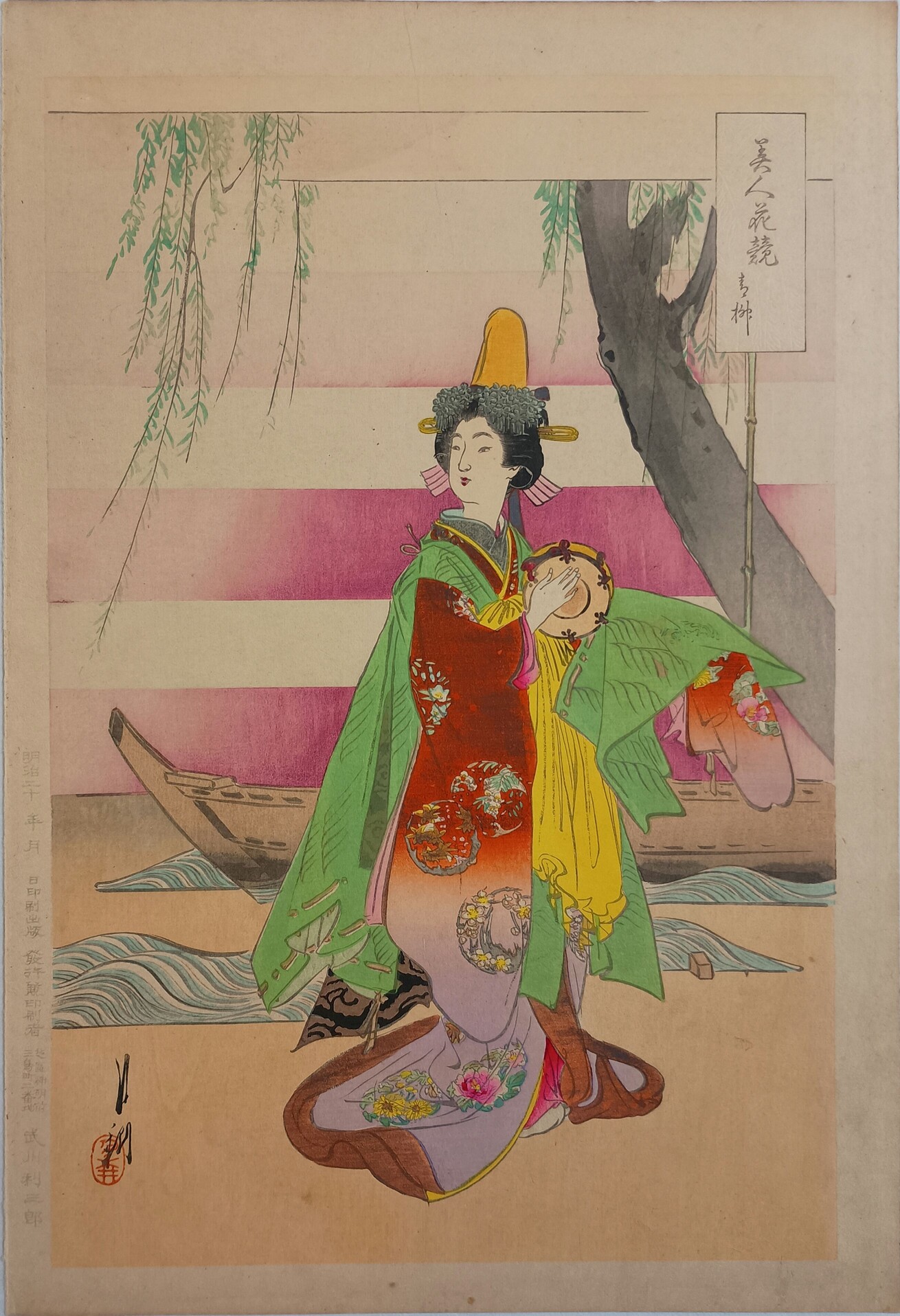
his work encompassed landscapes, bijin-ga, kachō-e, historical scenes, animals, and intimate depictions of everyday family life. His series Beauties at Famous Places, published in the early twentieth century, remains among his best-known bijin subjects.
Throughout his career, Gekkō refined a highly personal style that blended elements of ukiyo-e, Nihonga, Shijō painting, and Chinese artistic traditions. The result was a body of work whose visual richness often resembles painting more than conventional woodblock
printing. His artistic names included Kagyōrō, Meikyōsai, Nen`yū, and Rōsai. Among his few pupils, the most prominent was Tsukioka Kōgyo.
 Not for Sale
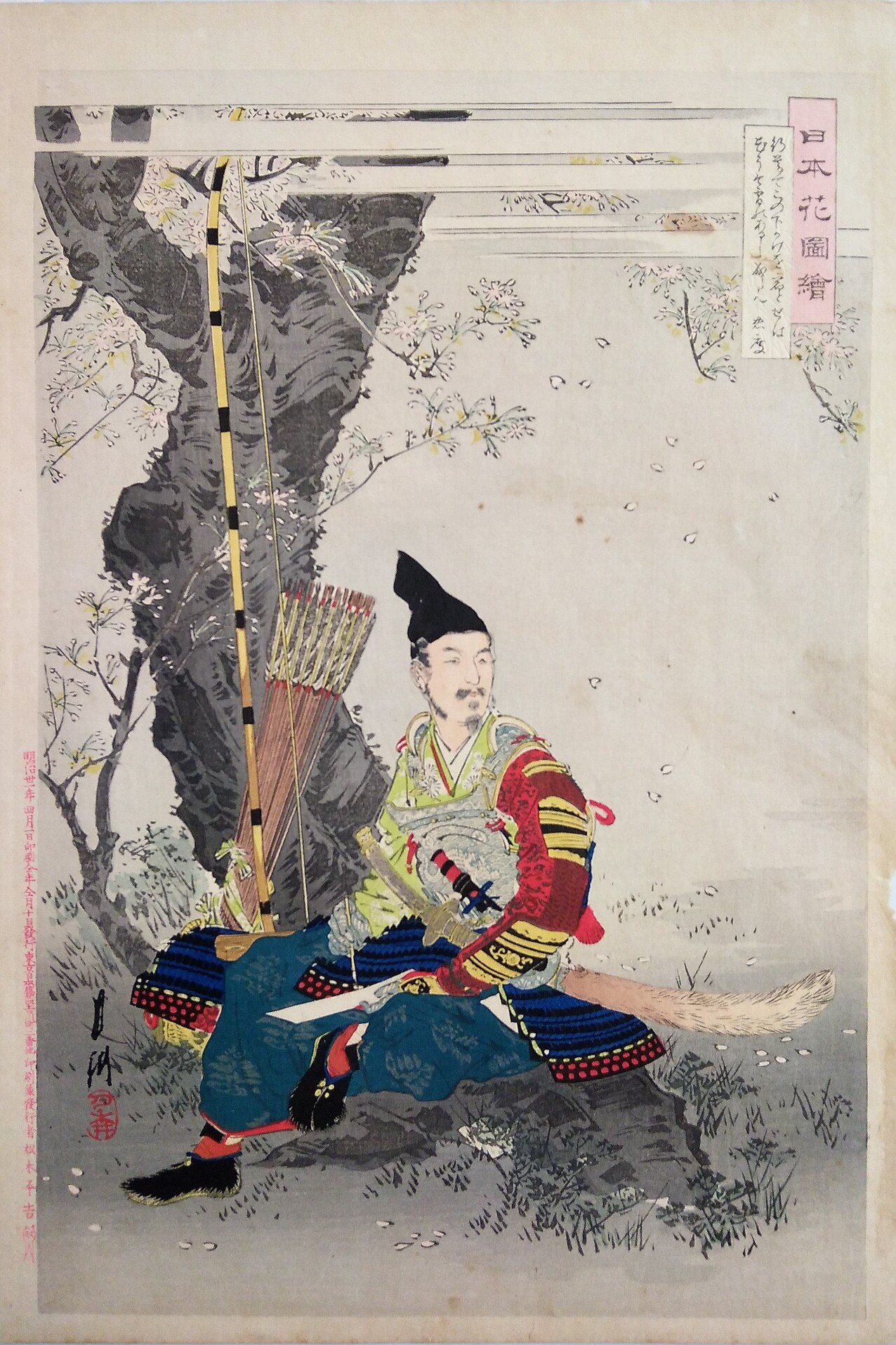
A warrior, presumably Taira no Tadanori, the brother of Taira clan leader Kiyomori, is depicted resting beneath a tree, composing a poem on a strip of paper.
The poem appears within the white cartouche in the upper-right corner of the print. It is drawn from Heike Monogatari (平家物語), one of the most celebrated war epics in Japanese
classical literature, and is traditionally attributed to Tadanori himself:
「行き暮れて 木の下陰を 宿とせば 花や今宵の 主ならまし」
Yuki kurete / ko no shita kage wo / yado to seba / hana ya koyoi no / jinaramashi
"As evening falls and I take shelter beneath the shadow of a tree,
might the blossoms above become my hosts for the night?"
The print employs refined techniques such as karasuri (空摺, blind embossing) on the white cartouche and kirabiki (雲母引, mica printing) on the warrior’s garment, adding both texture and elegance to the composition.
 Not for Sale
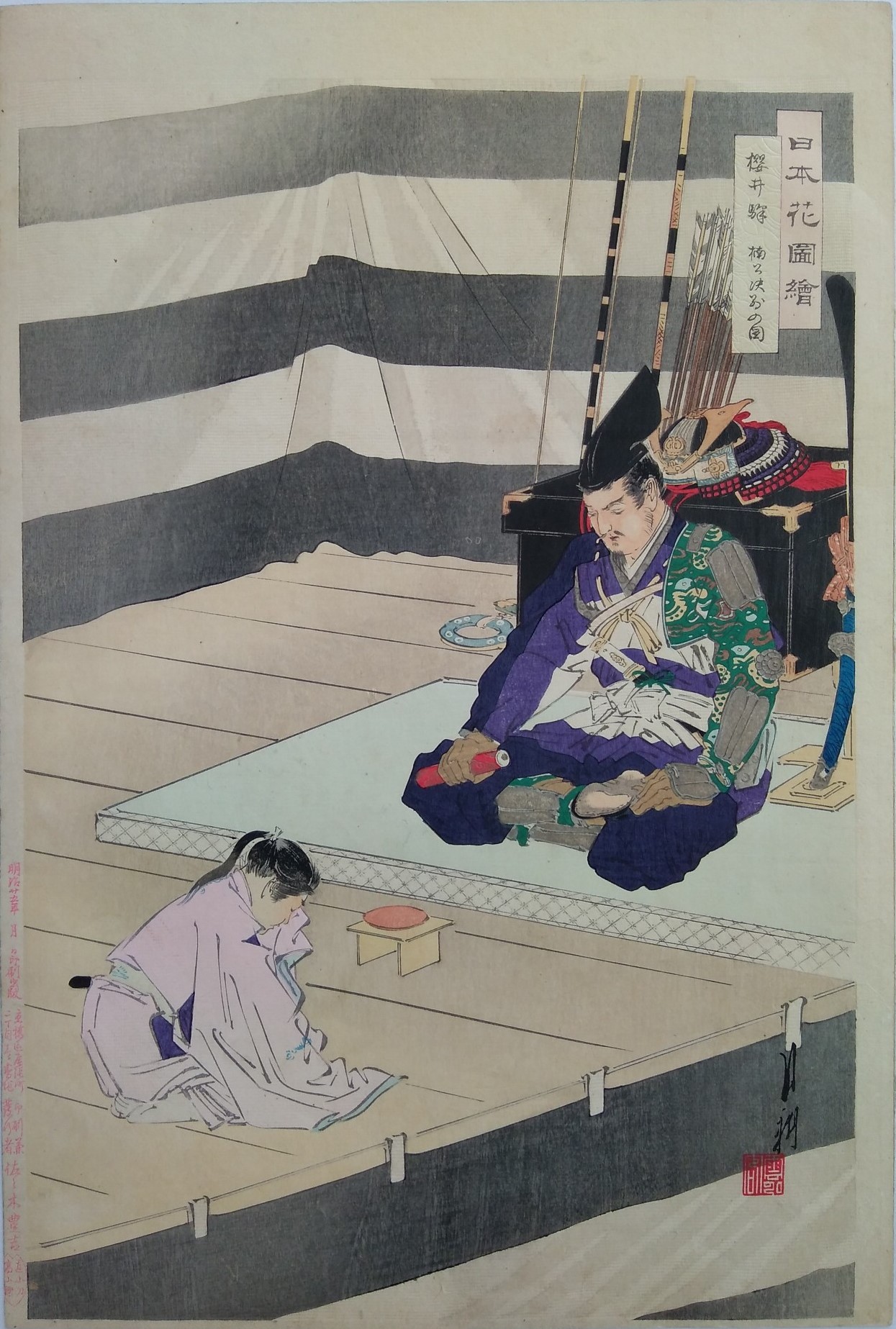
A portrait of Kusunoki Masashige, a samurai lived during the Kamakura era, in the moment of his farewell to his son Masatsura at Sakurai station which historical site is nowadays
located in the Osaka prefecture.
He is mainly remembered for having supported the Emperor Go Daigo in fighting for overthrow the Kamakura shogunate, restoring the Imperial Court for a brief three years period known as the Kenmu
Restoration.
He eventually died after it while keep fighting following his Emperor orders.
His popularity is associated to the ideal of loyalty and virtue and epitomized in the phrase "Would that I had seven lives to give for my country!"" (shichishō hōkoku, 七生報國) attributed to his brother Masasue.
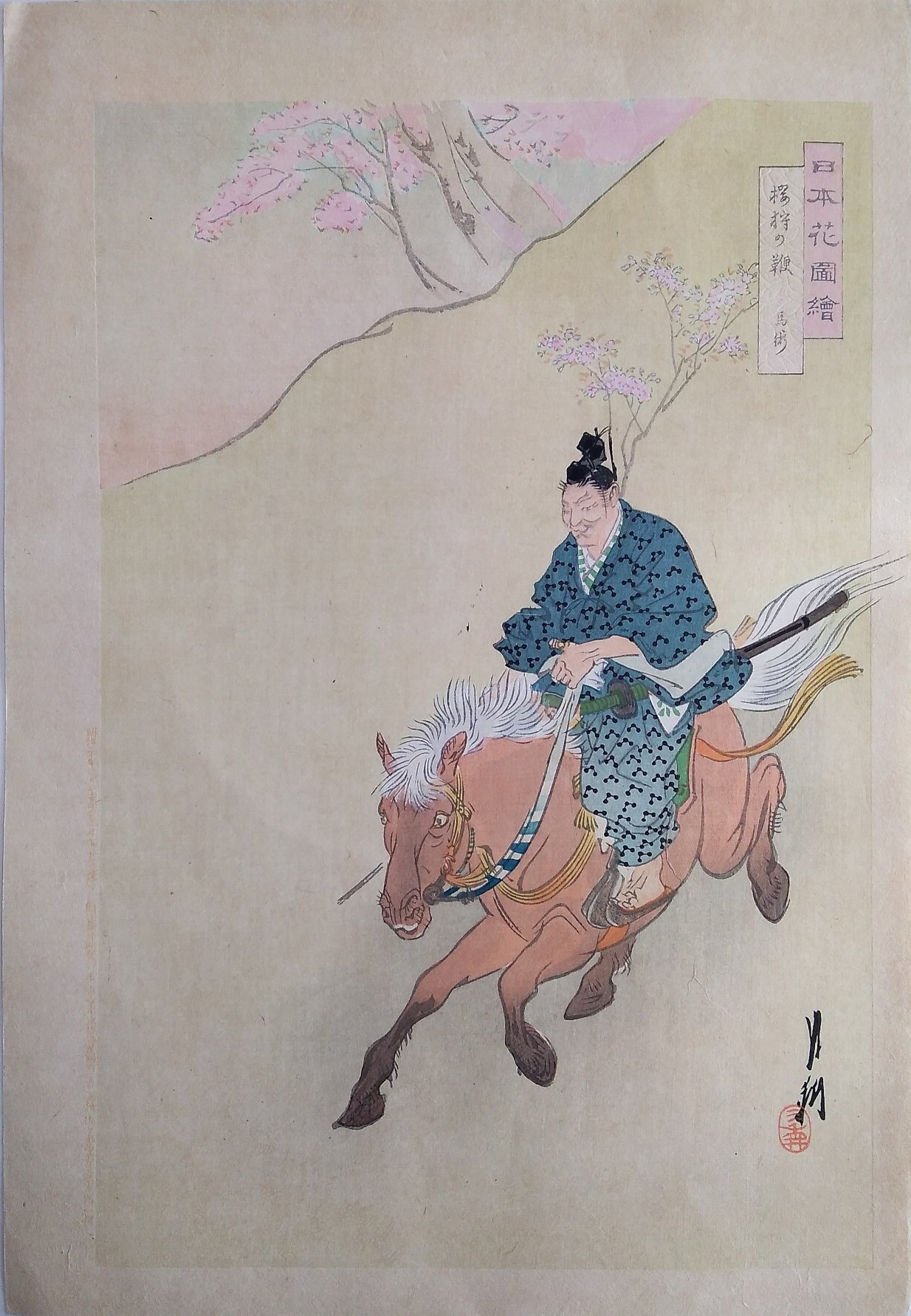
A lone rider descends a gentle hill beneath drifting cherry blossoms, capturing a fleeting moment of spring.
The title brings together bajutsu (horsemanship) and sakuragari, a poetic expression for enjoying the blossoms, much like hanami.
By extension, it may also suggest refined aristocratic pursuits—seasonal outings or even falconry (takagari)—set against landscapes admired for their beauty.
The image evokes a world where discipline and elegance meet, and where the warrior becomes part of the poetry of the season.
USD$ 169.00
 Sold Out
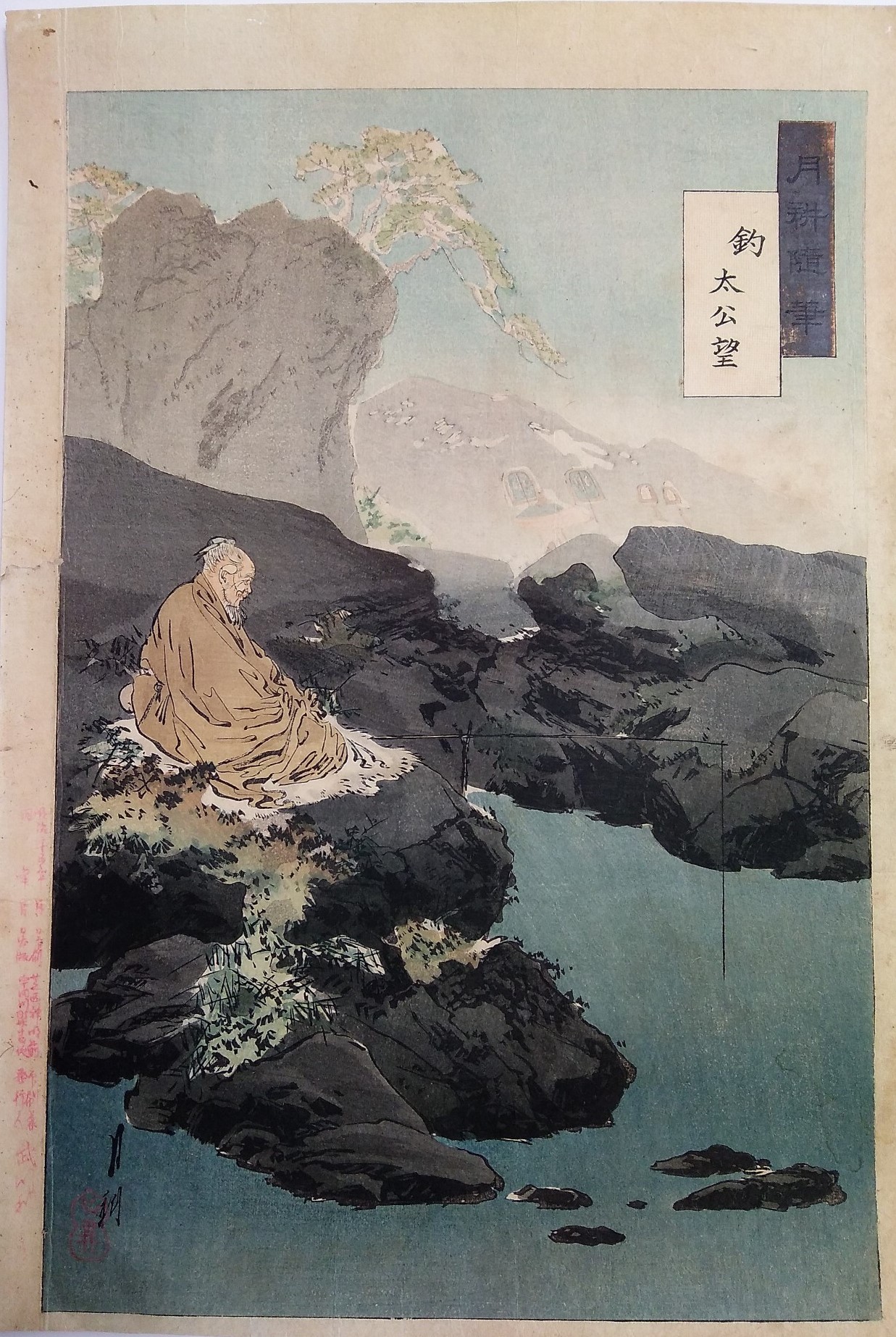
Taikōbō, also known which a plethora of different names among which the most notorious one is Jiang Ziya, was a Chinese noble mostly remembered for having
supported the kings Wei and Wu of the Zhou dinasty on fighting and overthrowing the Shang dinasty`s last ruler, King Zhou, who was a tyrant.
He had previously served the Shang dinasty for almost twenty years but being the last King an unbearable tyrant he chose to leave the kingdom.
He disappeared for decades leaving no traces, but in his early seventies he was eventually found and recruited by the King Wen of Zhou, when this one was having an hunting trip.
It is told that he spent most of his exile fishing alone in a branch of the Wei River near today`s Xi`An, waiting for someone asking his help for overthrowing the tyrant.
Sold Out
 Sold Out
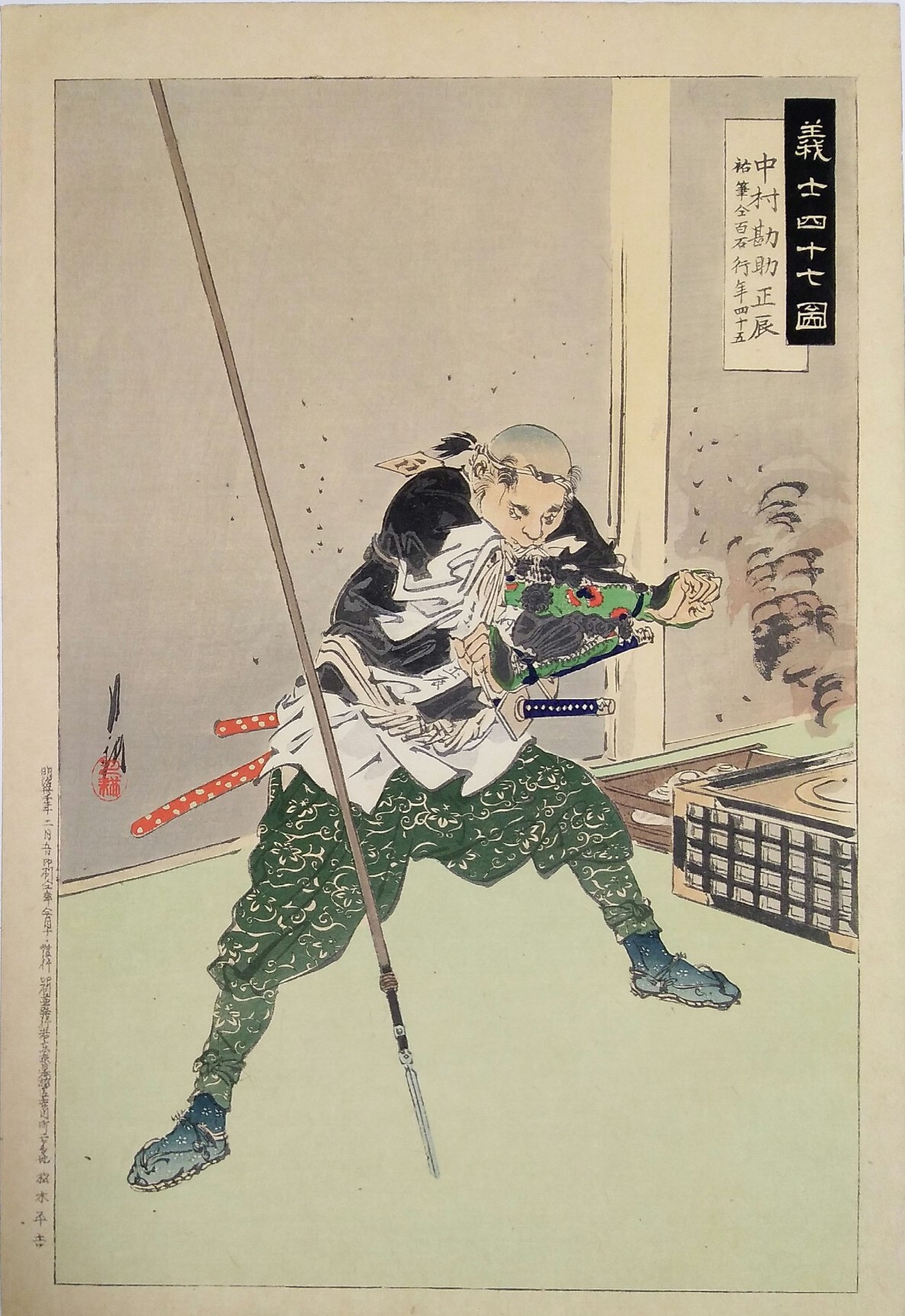
This print depicts the warrior Nakamura Kensuke Masatoki, taken from a version by Ogata Gekkō dedicated to the events of the forty-seven loyal retainers.
It is a second edition produced in February 1902 by the publisher Matsuki Eikichi, released following the first edition produced in 1896 by the publisher Takegawa Risaburō. It distinguishes itself from the first edition by some details,
such as the color of the sleeves (purple in the first edition) and the scabbard of the sword.
He was born in 1659 from a retainer of the Matsudaira family. In 1676 he became the son in law of Nakamura Shōsuke, a retainer of the Asano family of the Akō domain. In the same domain he served as scribe and horse attendant, eventually
succeeding to the family headship in 1682.
He was in Akō in 1701 when his lord Asano Naganori engaged in the vendetta against Kira Yoshinaka and even after the surrender of Akō castle he continued working in the domain, handle some minor affairs.
During the raid on the Kira residence, he joined the team assigned to the rear gate., primarily fighting those Kira`s retainers who were fleeing from the mansion. After that Kira was murdered, all the retainers surrendered then sentenced to
death by seppuku, the ritual suicide. He performed seppuku on February 4 1703, at the age of 45, assisted by Ōshima Hanpei from the Matsudaira faimly as kaishakunin, the person in charge of beheading the condemned after this has cut his belly.
Sold Out
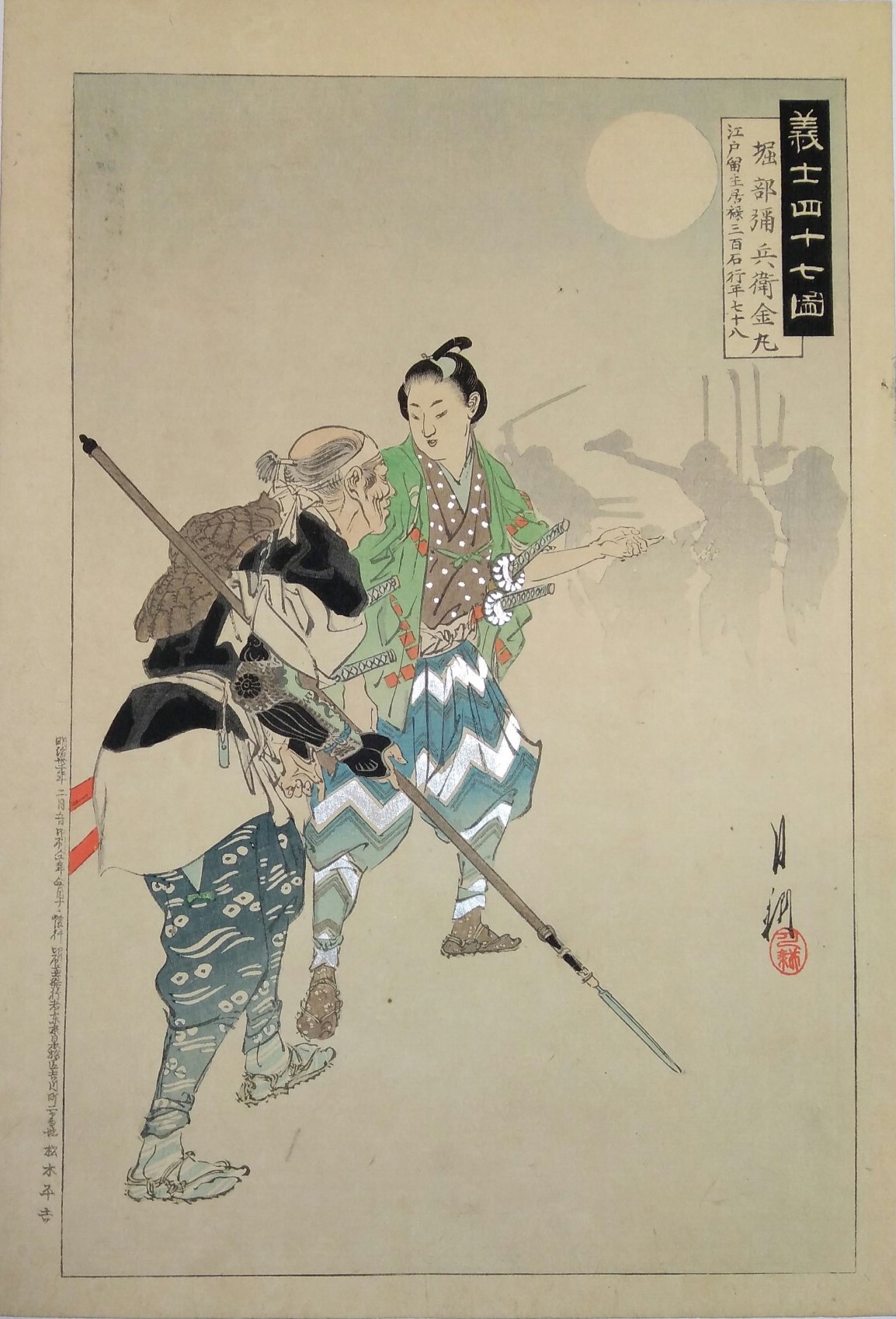
This print depicts the warrior Horibe Yahei Kanamaru, taken from a version by Ogata Gekkō dedicated to the events of the forty-seven loyal retainers.
It is probably a second edition produced in February 1899 by the publisher Matsuki Eikichi, released following the first edition produced in 1896 by the publisher Takegawa Risaburō. It distinguishes itself from the first edition by some details, such as the color of the trousers.
Kanamaru`s age at the time of the Akō incident may vary in historical accounts, but he was considered to be among the elder and more experienced members of the group.
Alongside Oishi Kuranosuke, the leader of the rōnin, Horibe was one of the key figures who motivated and kept the group united in their cause playing a crucial role in the planning and execution of the revenge against Kira Yoshinaka and a source of inspiration for the younger samurai.
His experience and wisdom were invaluable in orchestrating the attack on Kira`s mansion. He was involved in the strategic meetings that laid out the plan for revenge, contributing to the discussions on how best to approach and infiltrate Kira`s residence without arousing suspicion.
On the night of the attack, Horibe was among those who directly engaged Kira`s guards and played a significant part in navigating the challenges they faced. His actions during the assault were marked by bravery and a deep sense of duty towards completing their mission.
USD$ 250.00
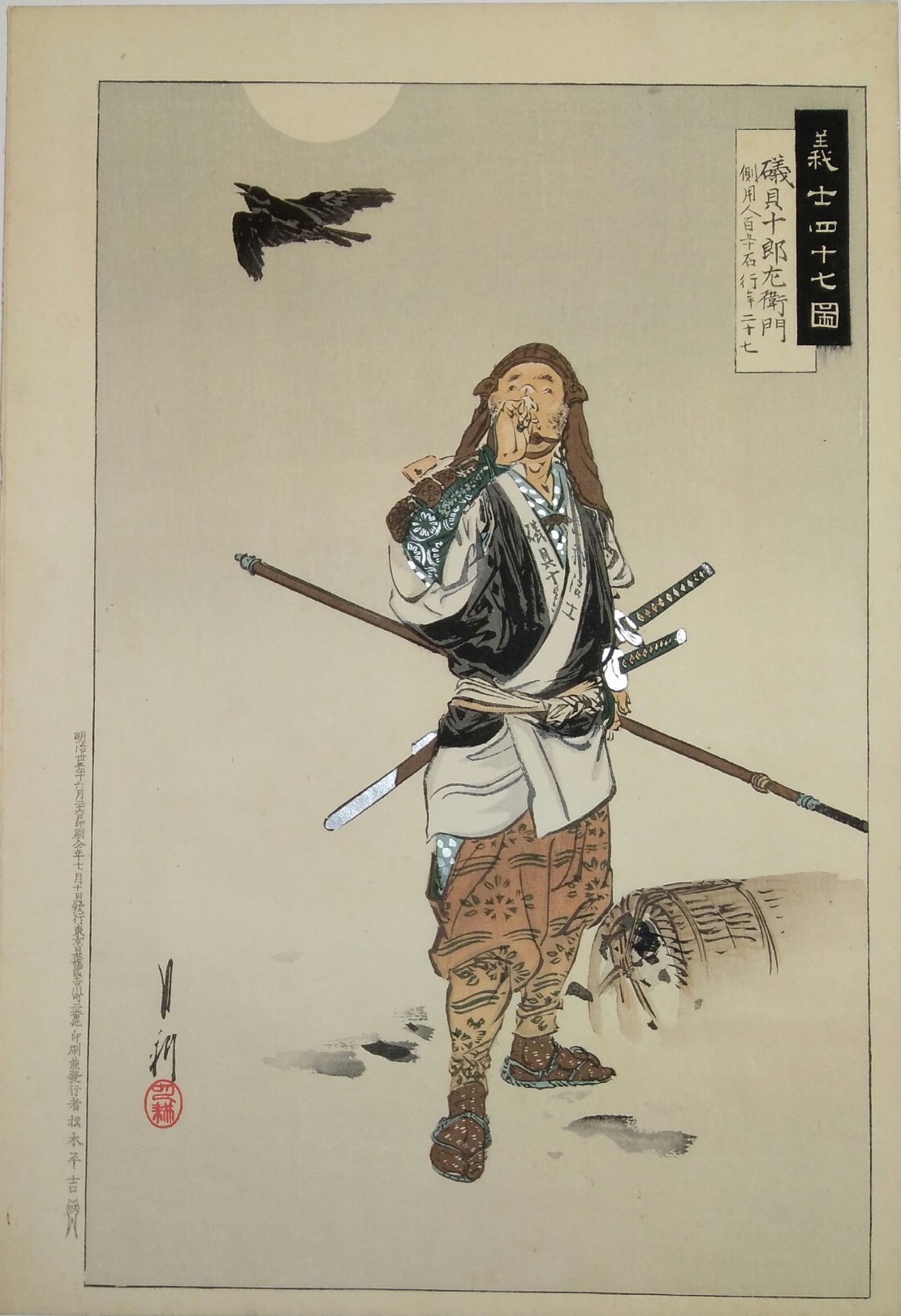
This print depicts the warrior Ishogai Jurozaemon, taken from a version by Ogata Gekkō dedicated to the events of the forty-seven loyal retainers.
It is probably a second edition published in June 1902 by Matsuki Eikichi, released following the first edition produced in 1896 by the publisher Takegawa Risaburō.
According to sources or various accounts, also known by the name Ishikawa Jurozaemon, Ishoga was one of the youngest warriors to take part in the Akō revenge. As understood from the cartouche
in the upper right, he was 27 years old at the time of the event.
USD$ 250.00
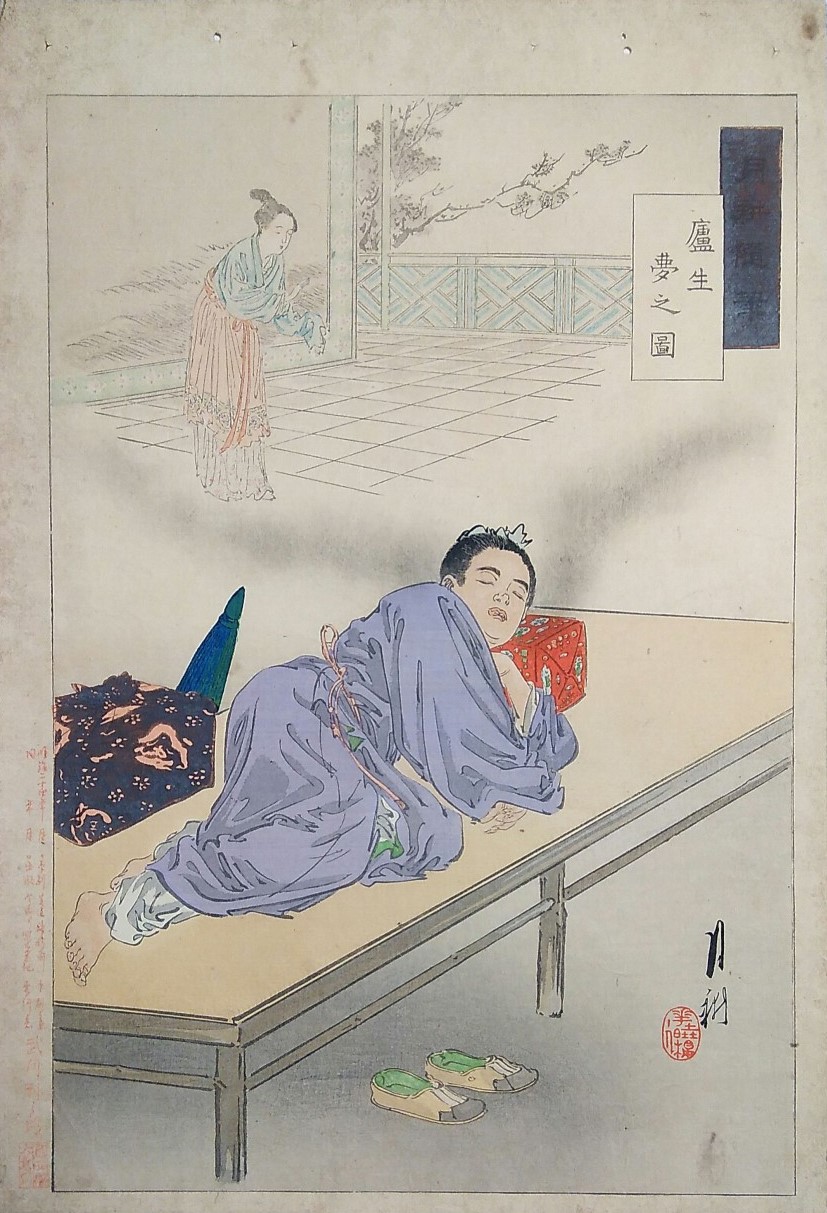
"The Dream of Rosei (or Rōshō)" is based on a Tang Dynasty legend about a poor young man named Rosei. After sleeping on a Taoist named Lu Dongbin`s magical pillow, Rosei dreams of a life
filled with extraordinary successes. However, this imagined life ends with a sudden fall from grace. The story symbolizes the ephemeral nature of success and human fortune, illustrating how reality can
change as quickly as in a dream.
This tale is often used to reflect on the transience of worldly glories.
USD$ 247.00