
Utagawa Hiroshige III
1842 ~ 1894Hiroshige III, born Gotō Torakichi in Edo (present-day Tokyo), was an ukiyo-e artist of the Utagawa school active during the second half of the nineteenth century.
The son of a shipbuilder from the Fukagawa district, he began studying as a teenager under the celebrated Utagawa Hiroshige I and, following his master`s death in 1858, continued his
artistic training under Hiroshige II. His early art name was Shigemasa.
After the dissolution of the marriage between Hiroshige II and Ōtatsu, the daughter of Hiroshige I, Gotō married Ōtatsu in 1867. He initially used the name Hiroshige II before adopting
the name Hiroshige III in 1869, becoming the third artist to carry the prestigious Hiroshige lineage. Throughout his career he also used several other art names, including Isshosai, Shigemasa, and Shigetora.
Hiroshige III specialized in landscapes and views of famous places, particularly in Tokyo. While his artistic style remained strongly rooted in the tradition established by his predecessors, his works reflect the
profound social and cultural changes of the Meiji period. Unlike the largely Edo-period landscapes of Hiroshige I and II, his prints frequently depict the modernization and Westernization of Japan, including railways,
brick buildings, foreign settlements, modern institutions, and new urban infrastructure.
In addition to his meisho-e (pictures of famous places), Hiroshige III became particularly known for his kaika-e (enlightenment prints), which documented Japan`s rapid transformation into a modern nation. Today, his works
are valued not only for their artistic qualities but also as important visual records of the dramatic changes that reshaped Japanese society during the Meiji era.
Questa versione è più vicina allo stile che abbiamo adottato per Hiroshige I, Hiroshige II e gli altri artisti del tuo catalogo: meno giudicante, più contestualizzata storicamente e maggiormente allineata alle fonti museali e accademiche.
 Not for Sale
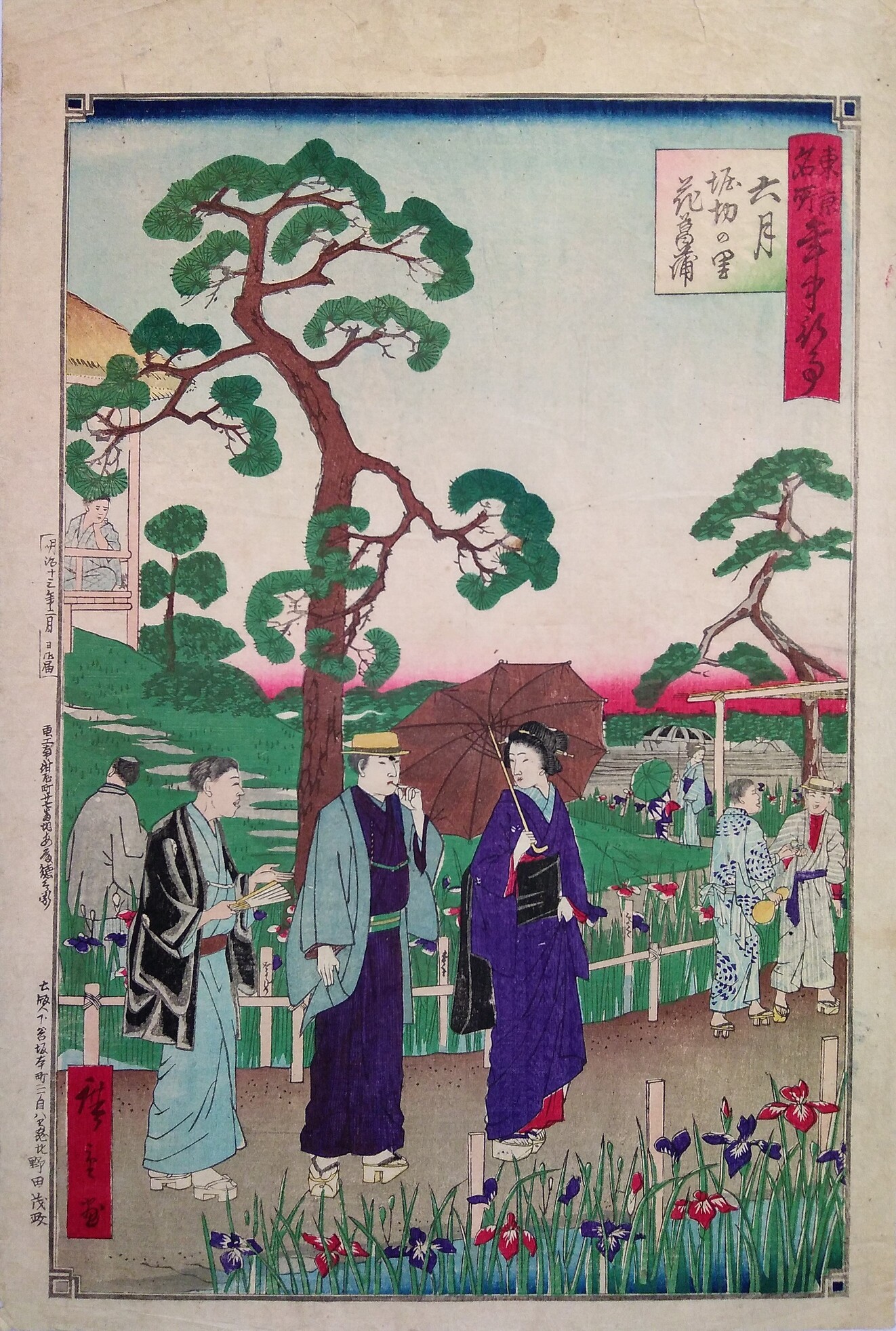
On an early summer day, people wearing yukata are having a walk by the Ayase river at horikiri, in the katsushika ward of Tōkyō, for the annual iris flower garden view.
Iris appeared in Japan in the 19th century, when a farmer named Iza`emon began the first cultivation. A great variety of this flower bloomed by the end of the Edo era, so many gardens were created.
Few of the characters in the print are pairing their traditional clothes with western apparel and accessories: the man in the forground is wearing a western style hat while another one in the right is wearing a red shirt under his yukata.
Attires like these were quite common to be seen in the Meiji era, where commoners used to add one or more western accessories (hat, shoes, umbrella etc.) to thier traditional clothes
 Sold Out